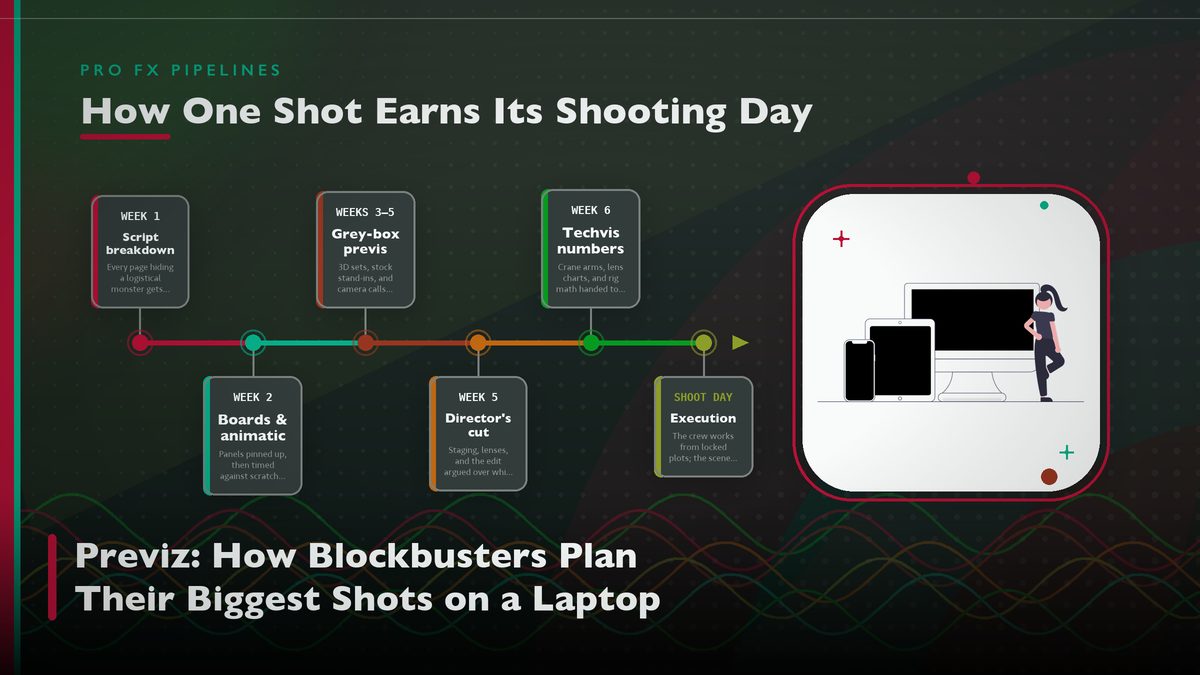
Before a single frame of a $200 million movie gets shot, somebody builds the whole film out of grey boxes and stick figures. That somebody, and that rough draft, decide whether the ending even works.
A few years ago I watched a visual effects supervisor open his laptop at a film festival Q&A and show the audience something embarrassing. His studio’s previsualization for a giant robot fight. The robots were untextured grey shapes, the city was a handful of cubes, and one character was literally a camera icon with a smiley face taped over it, more or less. The audience laughed. Then he played the finished scene from the actual film, and the laughter stopped, because the staging, the cuts, and the camera angles were already sitting there in the ugly version, shot for shot. Nobody puts that on a poster. Previz, short for previsualization as the term is catalogued on Wikipedia’s previsualization page, is the craft of making the movie badly and cheaply first, so the expensive version has a fighting chance of working. It is, if you want my honest opinion, the least glamorous discipline in the business and the one that quietly decides whether a blockbuster lives or dies.
It sounds like a scheduling formality. Until you see the money involved, it even feels like one. But big productions treat previz as the real creative work, because directors discover their films inside it, studios approve nine-figure budgets based on it, and once you know what a previz team actually delivers you start spotting its fingerprints everywhere: action you can follow, staging that finds energy out of nowhere, endings that land instead of sagging at the finish line.
What Previz Actually Is (and What It Isn’t)
Previz is the art of mocking up a film’s complicated shots before anyone rents a crane. A small team of artists, often three to eight people even on a huge show, builds simplified 3D versions of the sets, drops in rough characters, blocks the action, and cuts it together with sound effects and temp music. The finished product looks like a video game from 2004. That’s fine, because nobody outside the production is ever supposed to see it. Good enough is the brief.
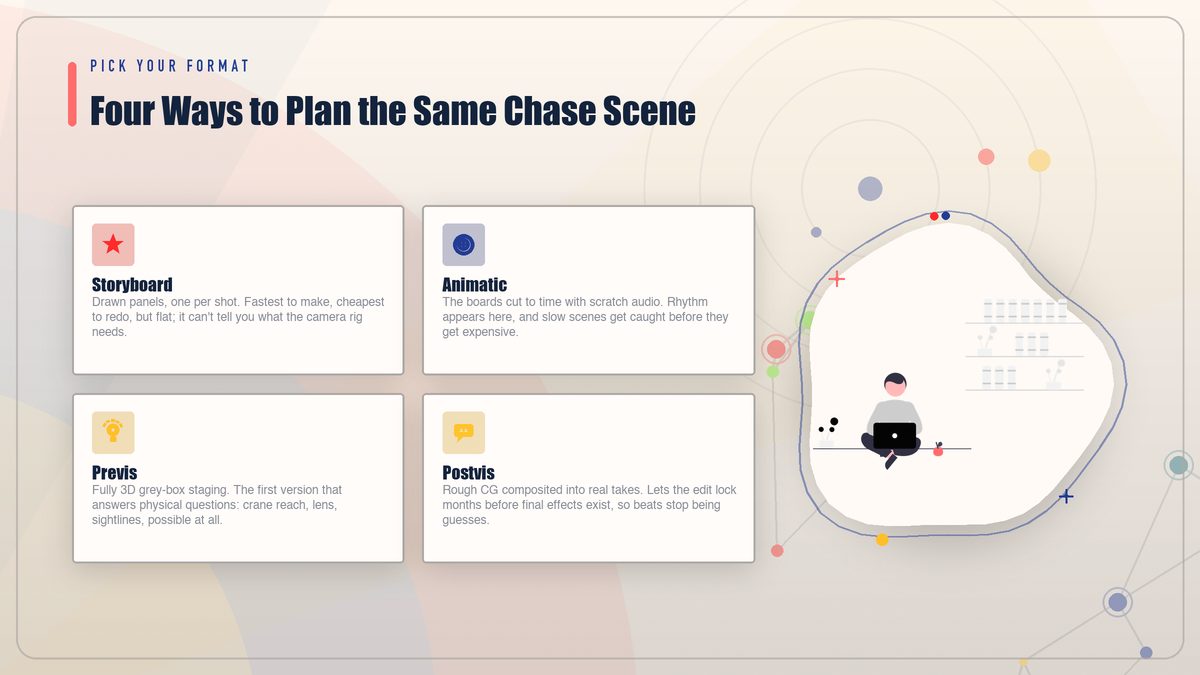
Four related terms get mixed up constantly, so let’s sort the vocabulary before anything else, since the departments argue about it too. A storyboard is a series of drawn panels, one per shot, usually pinned to a wall somewhere near the production office. An animatic is those same drawings edited into a timed sequence with scratch audio, so you can feel a scene’s rhythm. Previz goes further, because it’s fully 3D, which means you can move the camera and find out a scene doesn’t work before any actor hears about it. Postvis comes last, after the shoot, combining real footage with rough effects so executives can watch a cut that doesn’t look like a shrug.
Boards tell you composition. Animatics tell you timing. Previz tells you whether the shot is physically possible at all, which is the distinction that matters and the reason the work migrated from paper into 3D software in the first place. On paper, every shot is possible; in a 3D scene, the software starts asking awkward questions about where the camera rig stands, how far a crane arm reaches, and whether the building even has a roof to hang the helicopter shot over.
From Pinned-Up Drawings to Game Engines
None of this is new, and that surprises people. Storyboards go back to the early Disney shorts of the 1930s, when the studio pinned sequential sketches above the animators’ desks and discovered that planning a cartoon beat by beat beat improvising one. Live-action directors picked the habit up quickly, and by the 1950s Alfred Hitchcock had become famous for boarding entire films before shooting, treating principal photography itself as almost clerical. That’s the extreme version, mind you. Most directors board selectively, the action sequences and the tricky setups, and leave dialogue scenes loose for the actors. Boards came first.
What changed across the 1990s and 2000s was dimension. CGI made it possible to mock up not just what a shot looks like but where everything sits in space, and productions heavy with effects work, the Star Wars prequels being the usual example, started doing their planning directly inside 3D. The logic was simple enough to fit in one sentence. If half your shots will be finished by a computer anyway, the planning ought to happen in the computer’s home turf.
Then game engines arrived and rewrote the economics completely. Tools like Unreal Engine and Unity can render a city street, a spaceship interior, or a kaiju attack in real time, so a director can grab a virtual camera and film the previz the way you’d shoot a documentary instead of describing it in emails. Work that took an artist a week of rendering one frame at a time can now be blocked in a single afternoon, and I don’t think it’s an exaggeration to say the game engine moved this craft forward further in ten years than three decades of workstation software managed before it.
The Previz Pipeline, Step by Step
So what does the work look like on a big production? The shape of it stays consistent from show to show, though every production bends it a little at the edges, because a dialogue-driven drama and a citywide robot war demand very different things from the same basic skeleton.
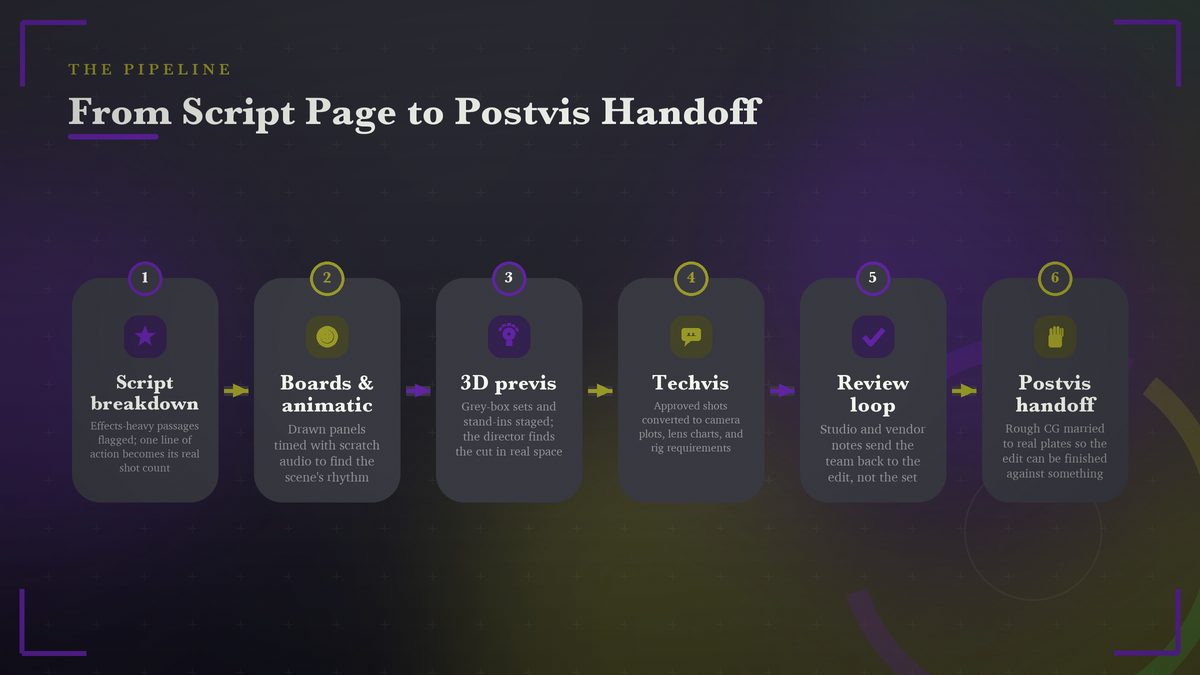
Everything starts with a script breakdown. The previz supervisor, usually sitting with the first assistant director and the effects supervisor, flags every passage where the words on the page hide a logistical monster. “The hero leaps between rooftops” reads like one line, yet it becomes sixteen shots and three stunt rigs if you shoot it in daylight, or one crane move and a background plate if you don’t. This pass alone can kill a sequence before it eats a month of prep.
From there the team builds the digital sets, which is unglamorous in a way I find weirdly charming. Architects’ floor plans get extruded into grey rooms. A parking garage becomes twelve concrete columns and a ramp. Character stand-ins are stock humanoids that every studio seems to own some variant of. Speed matters far more than beauty, because the entire asset is disposable and nobody has ever been paid to polish a previz hallway, not once, ever.
Blocking comes next. That’s where the director earns the money.
Working with the previz artists the way a conductor works an orchestra, the director stages the action, calls the lenses, and finds the cut. Fight choreography gets tested against real stunt timing, because you can’t ask an actor to throw a punch that takes fourteen frames when the board says eleven. Chase geography gets fixed here as well, since a pursuit that makes perfect sense on a map often falls apart the moment you drive it with a camera. When this pass ends, the production owns something film history never had before, which is a complete rough draft of scenes that don’t exist yet.
Review screenings follow, and they’re brutal in a useful way. The director, producers, the studio, sometimes the effects vendors all watch the animatic and take notes, and the numbers they argue over are cheap ones: swap a crane for a drone move, shift an explosion two streets over, cut the shot that requires the second unit. Numbers settle arguments.
Compare that with the identical argument happening on a location day with three hundred crew members standing around, and the value of the exercise stops being theoretical.
Techvis: The Spreadsheets That Save Shoots
If previz is the creative pass, techvis is its accountant sibling. Techvis takes the approved sequences and converts them into engineering, meaning exact camera positions, lens focal lengths, crane arm lengths, light placements, and the distances between all of them. When a shot calls for a camera to fly off a building and down into a street, techvis answers the questions a director never wants to hear on the morning of the shoot. How big an arm does the crane need. Can the truck actually get it there. What does the building’s insurance say about drilling into the facade. Answer early, shoot once.
Specialist studios handle a large share of this work for Hollywood. Houses like The Third Floor, named after the floor of a major studio’s building where its founders worked, and Halon Entertainment run previs and techvis on a big chunk of the franchise pictures released each year, sometimes several competing productions at once. Their deliverables are unsexy and absolutely load-bearing, a package of camera plots, lens charts, and rig requirements that the first assistant director turns into a shooting schedule.
A concrete example makes the value obvious. Say a scene needs a camera tracking alongside a speeding car for forty seconds. Techvis computes the pursuit vehicle’s speed, the stabilized head’s weight limits, the road’s minimum turning radius, and whether the background will stay out of frame reflection at that angle. Get it wrong and the day is lost, get it right in a spreadsheet and the day is a formality. One well-run techvis pass, I’m told, routinely pays for an entire previz department’s month.
Postvis: When the Rough Draft Meets Real Footage
Shooting doesn’t end the relationship. Once real plates exist, the previz assets get a second life as postvis, with the rough robots and grey cities composited into the actual takes so editors and studios can watch a cut months before the effects houses deliver finals. If you’ve ever seen leaked work-in-progress trailer footage with half-finished creatures sliding through shots, you’ve seen postvis doing its job badly, usually under a deadline nobody respected. (The leaked rough cut of a famous superhero film a while back was almost entirely postvis, and people acted scandalized, as if the studio had released the wrong movie.)
Good postvis changes what editing can be. An editor cutting around missing effects is guessing, while an editor cutting against postvis makes real decisions about rhythm and performance, and the effects team downstream inherits an edit that won’t get thrown out. Whole emotional beats get found in this stage on effects-heavy films, a held reaction shot here, a trimmed pause there, and those beats ride untouched into the finished movie. Beats survive this stage.
Why Changing Your Mind Gets Expensive
The argument that settles every budget meeting about previz comes down to one observation. The cost of changing a creative decision multiplies as production moves forward, and it multiplies fast. The industry shorthand runs in orders of magnitude, roughly one unit of cost to fix something in previz, ten on a shooting day, and a hundred or more once the shot is deep inside the effects pipeline. Nobody treats those ratios as accounting, but everybody treats them as direction. The math is brutal.
| Stage | Changing one shot costs roughly | Who’s in the room when you do |
|---|---|---|
| Previz / animatic | An artist’s afternoon | Director, a previz artist, a coffee |
| Shooting day | A day of crew, equipment, location fees | 150-300 crew members standing by |
| Postvis / edit | Re-editing plus vendor time | Editor, studio, effects vendors rebooked |
| Final effects | Weeks of vendor iterations per shot | A vendor pipeline and its render farm |
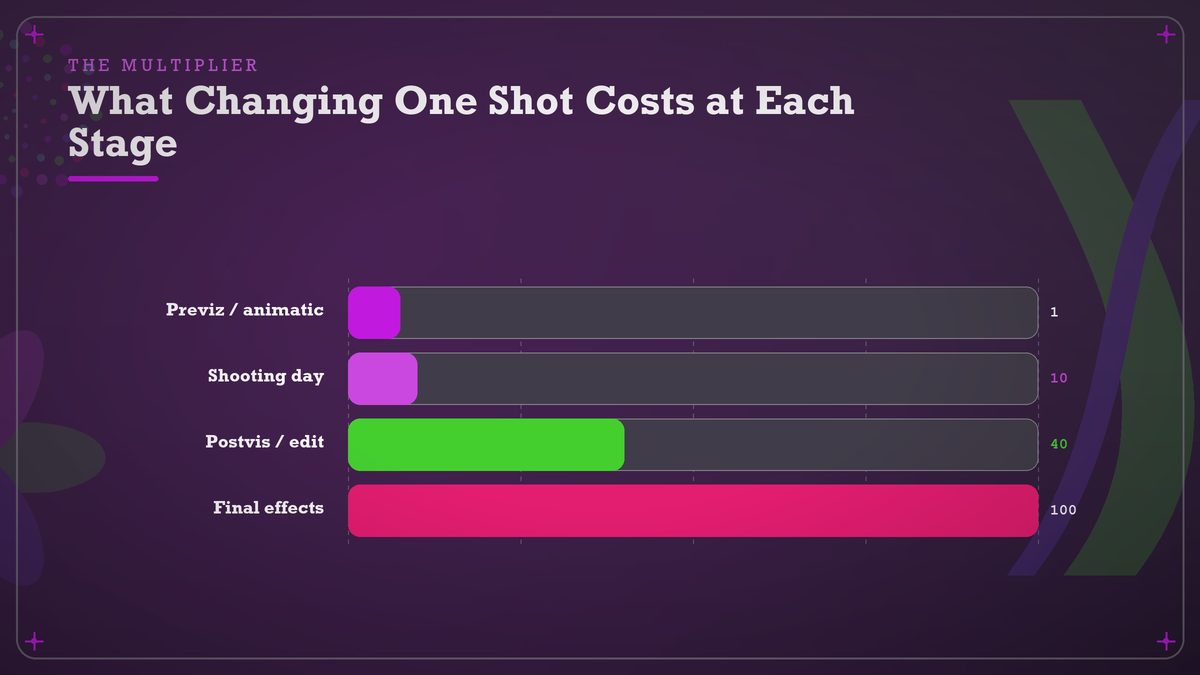
That’s why the smart framing isn’t “previz costs money.” Productions were going to have all these arguments somewhere, and previz lets them happen at the price of a workstation instead of the price of a shooting day. Every downstream department inherits the assumptions locked in here, as our CGI pipeline breakdown covers in detail, which makes previz the cheapest place in the entire chain to be wrong.
Previz in Your Pocket: The Indie Version
None of this belongs exclusively to nine-figure productions anymore, and honestly that’s the fun part. The same game-engine technology that runs studio previz is effectively free now, and the learning curve, while real, amounts to a weekend or two of stubbornness for anyone already comfortable with video editing.
The pragmatic indie stack looks like this. Blender handles the 3D side, grey-box sets and simple characters and camera animation, with Grease Pencil adding storyboard-style overlays directly on the 3D scene, a trick big studios would have traded a kidney for in 2005. Game engines give you real-time walkthroughs if you prefer blocking action like a shooter game. For the animatic itself, DaVinci Resolve ships a full editing page in its free tier, so you can cut your previz to scratch audio without spending a dollar, and Unity’s free personal license rounds the kit out when real-time blocking appeals. Cost of entry: zero.
Does a $40,000 short film need a full previz department? Of course not, and nobody’s suggesting one. But the one sequence in your film that worries you, the car stunt, the fight, the thing you’ll get exactly one attempt at, deserves the grey-box treatment. Block it in 3D, cut it against music, show it to one honest friend, and count the problems they find. Each one you fix at your desk is a problem that doesn’t eat a shoot day. I’ve storyboarded sequences that fell apart the second I saw them in motion, and I’ve grey-boxed others that turned out to need half the shots I thought they did. Both discoveries cost me an evening.
Where Previz Changed a Famous Movie
The clearest public case study is Avatar. James Cameron’s team built what they called a virtual camera, a monitoring rig that let Cameron stand on a bare motion-capture stage, look through a lens at Pandora’s fully rendered world, and direct CG scenes as if he were shooting a documentary. The entire film was essentially prevized at performance quality before traditional photography existed in the usual sense. Love the movie or find it smurfy, the pipeline work ran a decade ahead of the industry, and most of what virtual production does today is still chasing that workflow.
And the practice keeps absorbing new jobs. On Gravity, a film made of almost nothing but “impossible” shots, previz and its techvis sibling were the production itself, with the stars photographed inside a light box while every camera move had been computed and rehearsed long before anyone rolled. Even stubbornly practical directors lean on it now, for the same reason everyone else does: it makes the expensive version safer. Our motion capture article covers how that side feeds the pipeline, and previz is where the feeding plan gets written.
Watch the pattern repeat across decades. The films we remember for spectacle are usually the ones where the spectacle was rehearsed to boredom before a single expensive thing happened. Boring, cheap, grey, those are a blockbuster’s best days, and it was true long before computers had a say.
Related reads: the modern CGI pipeline and what motion capture actually records. External sources are checked periodically; if a link has gone stale, tell us in the comments and we’ll swap it.