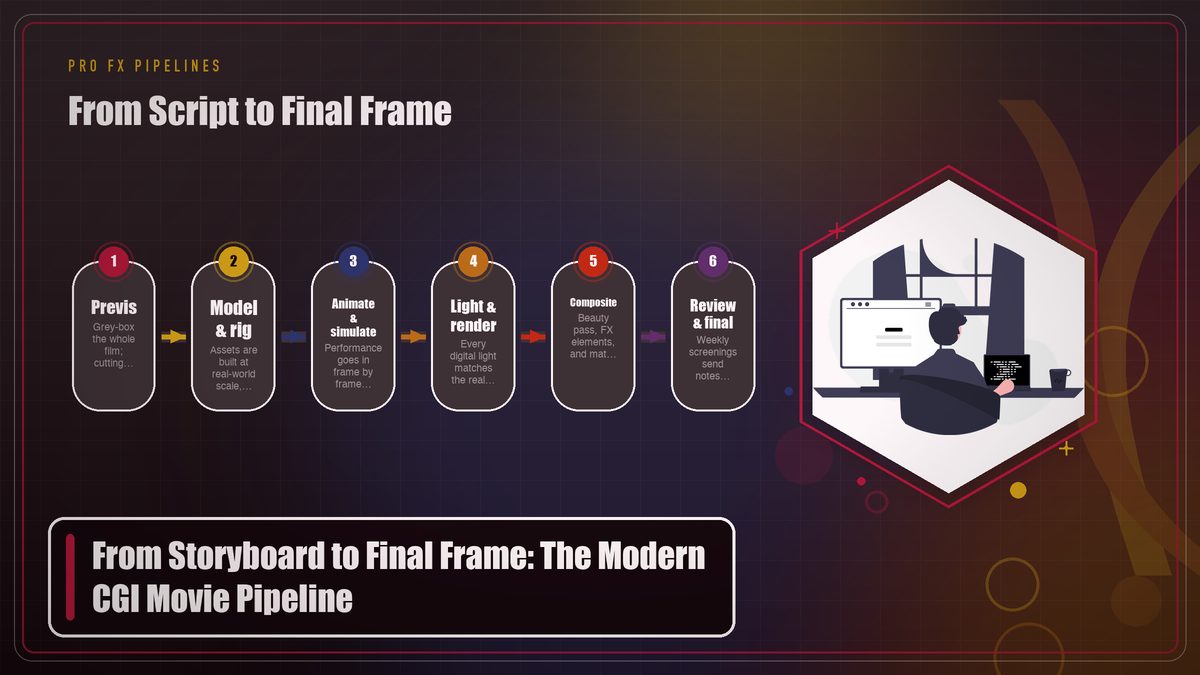
A single effects shot in a modern blockbuster can pass through ten departments and several hundred artists before it ever reaches a theater screen. This is what actually happens at each stop, and why finished shots routinely travel backward through the line.
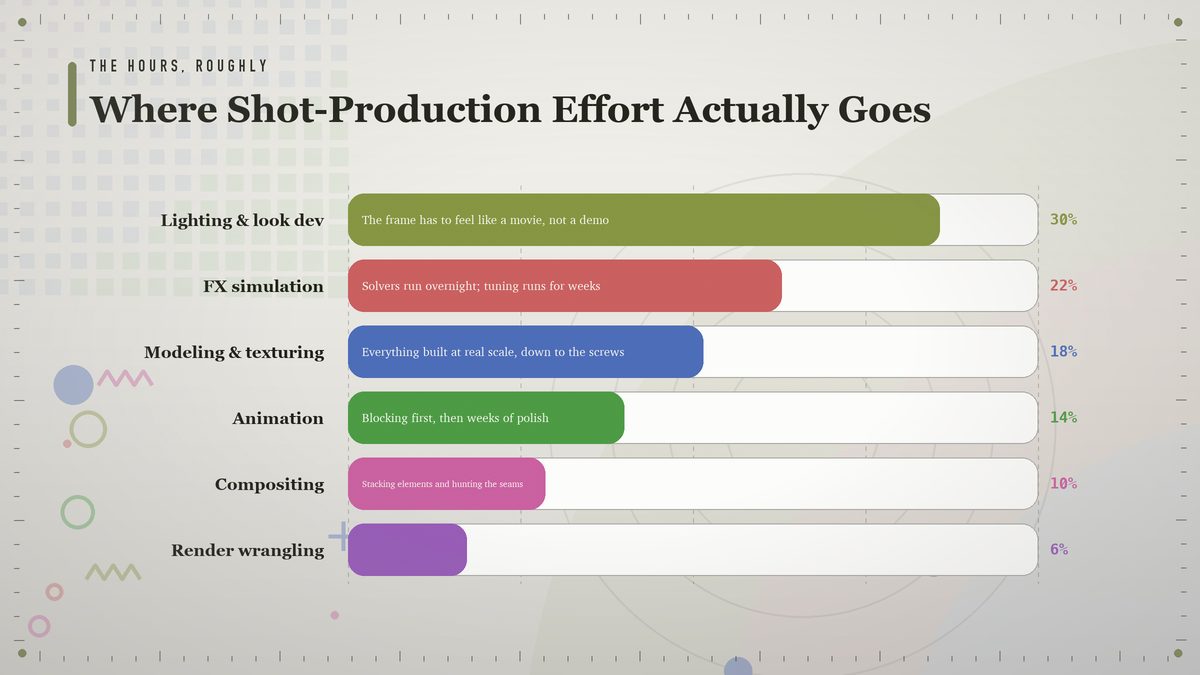
I used to think CGI was one job, like carpentry. You sit at a computer, you make the dragon, the dragon flies around, done. Then I watched a lighting artist spend three days adjusting the color of a single lamp in a scene that already looked fine to me, and I started asking how the whole machine fits together. It turns out a finished effects shot works more like a relay race where every runner can send the baton back if they don’t like the grip. Nobody works on the whole shot. Everybody owns one slice, and the slices move in a fixed order that artists call the pipeline. Simple in theory. Run the stages out of sequence, or skip one, and the shot falls apart in ways that cost real money to untangle.
The pipeline exists because computer animation doesn’t scale any other way. A feature might carry 1,500 visual effects shots, and at 24 frames per second, even a modest six-second shot means 144 final frames, each one assembled from dozens of layered elements that were built, lit, and rendered separately. No artist holds that in one head, so the work splits into stages, each stage owns a single handoff, and software tracks the versions so a late animation change doesn’t silently wreck lighting that was approved two months earlier.
One Shot, a Dozen Hands
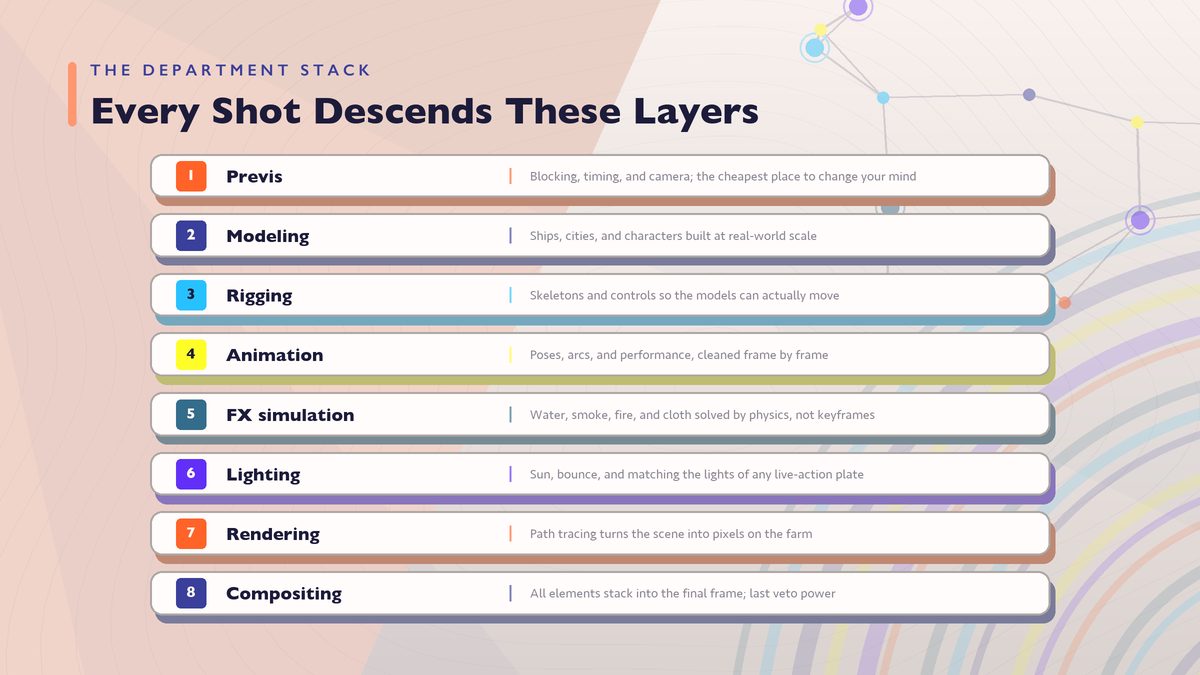
Follow one ordinary shot, say a character walking out of a crashed spaceship while smoke drifts past, and count the hands it touches. Someone boards it in previs. A modeler builds the ship. A rigger checks that the character’s elbow bends like an elbow. An animator blocks the walk, then polishes it for weeks. A simulation artist grows the smoke. A lighter places the sun. A renderer turns all of that into pixels, and a compositor stacks the pixels into the image you actually see. Nine people, minimum. On a big show it’s closer to twenty, because modeling alone splits into hard-surface, character, and environment teams.
The order matters more than outsiders expect. You can’t light a shot before it’s animated, because the light has to land where the character actually stands, and you can’t run the smoke before anyone knows where the door opens. Each stage bets that the earlier stages are finished, which is why the phrase “locked shot” gets thrown around so much. It means stop touching it, people downstream are building on this.
Previs, the Movie Before the Movie
Long before anyone builds a real asset, the previs team makes a crude version of the film. Blocky characters. Grey boxes for sets. Placeholder explosions, expanding orange spheres. It looks laughably rough, and it’s probably the most important stage in the whole pipeline, because previs answers the questions that are cheap to settle with stick figures and brutally expensive to settle with finished effects. Does the cut work? Can the camera physically get there? Is this six-page chase two minutes of screen time or seven?
Previs editors cut their animatics to the real script, and directors use those cuts to make decisions that ripple downward for a year or more. Every choice leaves a trace. If the animatic says the chase plays better at night, that call lands on the lighting and compositing teams, and it reshapes the render budget months before a single finished frame exists. Some productions now shoot previz inside game engines with virtual cameras, so a director can walk through a set that doesn’t exist yet. The previs department keeps the receipts, too, because every decision gets a timestamped version, and eighteen months later, when someone in post asks why the shot was built that way, there’s an answer on file.
Modeling, Rigging, and the Art of Digital Sculpture
Modeling is where the assets get built. Hard-surface modelers construct spaceships and buildings with the obsessiveness of people who know the camera will linger, and character modelers sculpt digital clay. They push virtual muscle around a skeleton until the anatomy reads. ZBrush is the usual chisel, and Maxon’s ZBrush page shows what the sculpting side of the industry runs on. Everything gets built at real-world scale. A door is two meters tall whether the audience ever knows it or not, because lighting, physics, and camera optics all depend on it. Scale is law.
Rigging comes next, and it’s the stage almost nobody outside the industry has heard of. A rig is the puppetry apparatus inside a model, the skeleton and muscle deformers underneath, plus the control curves the animator grabs to move the whole thing. A good character rig hides hundreds of controls behind a friendly face, with sliders for eyebrow arcs and switches for how the cloth drapes. The Blender manual’s chapter on armatures and rigging gives you the working vocabulary, since the underlying ideas travel across every major package. Riggers describe their own job as building a marionette that has to survive being grabbed by a hundred different animators, and the metaphor holds up.
The rig is the marionette nobody outside the industry has ever heard of, and a bad one makes every animator on the show look worse.
Animation, One Twenty-Fourth of a Second at a Time
With a rigged character, animation can start. Blocking comes first. The main poses go in roughly, timed to the dialogue or the stunt, to find the shape of the motion. Then the long polish: arcs corrected, holds stretched, one finger nudged a few degrees because it read as nervous instead of calm. The twelve principles animators wrote out in the 1930s still govern all of this, which is why studios keep that old Disney memo around.
Performance capture fits in here too, though the suit is a starting point rather than a finished performance. A captured take gets retargeted onto the rig and then cleaned, often frame by frame, because the digital character’s proportions don’t match the human performer’s and the raw data jitters. Animators describe the job as being handed somebody else’s handwriting and asked to forge the signature well enough that the writer can’t tell. It’s not faster than animating from scratch, they say. Just different.
Simulation, Where Physics Gets Its Own Department
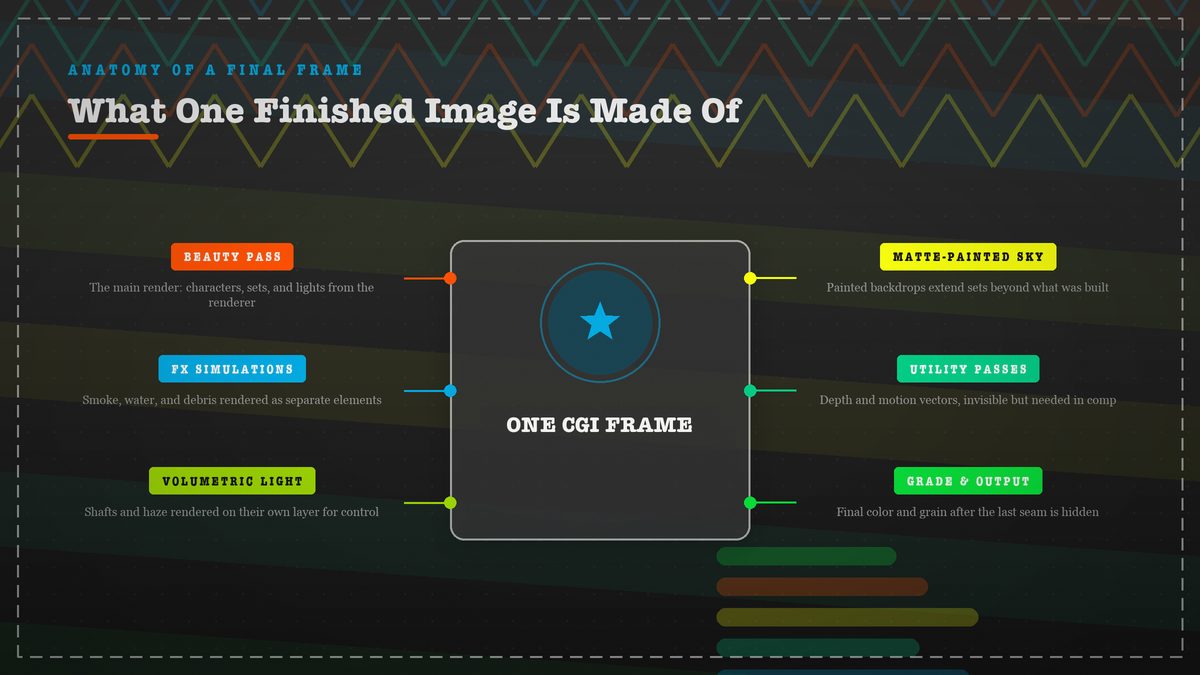
Smoke, water, fire, cloth, hair, collapsing buildings. Anything that obeys physics rather than intention goes to the FX simulation team. These artists don’t animate a wave by hand. They set up a solver, a grid of voxels or a cloud of particles, tell it how water behaves at this temperature and this scale, drop the ship into it, and let the math run overnight. The standard tool is Houdini, and a senior FX artist is part physicist, part gardener, tending a simulation and pruning its settings until the randomness happens to break the right way. Ask one about a water shot and the answer starts with particle separation and viscosity, because the art hides in the numbers.
The outputs are heavy in a way that’s hard to appreciate. One hero fluid simulation can cache out hundreds of gigabytes of voxel data, and productions keep those caches around because re-simulating a finished shot is the kind of mistake people bring up at the wrap party. Storage has become one of the sneaky line items on a modern effects budget, and the studios that win bids tend to be the ones whose data management is boring and bulletproof, which is a strange sentence to write about an art form.
Which is where the trivia comes from. Simulation bugs produce the clips artists pass around forever, the cloth that explodes off a character, the liquid that climbs a wall like it’s alive. Also, they never get old.
Lighting and Rendering, the Stage Where Money Becomes Pixels
Lighting is where a shot stops looking like a tech demo and starts looking like a movie. Lighters place the sun and the bounce cards, tune how the ship’s hull throws green onto the smoke, and match every digital light to the real plate whenever live-action photography sits in the frame. Their reference is always the real world, and the best lighters I know keep folders of personal photographs the way other people keep recipes. The habit exists because the eye forgives invented geometry long before it forgives invented light. A stylized spaceship reads as a design choice; a stylized shadow reads as a mistake.
Then rendering converts the whole constructed scene into pixels, and this is where the computing bill arrives. Modern renderers use path tracing to simulate rays of light bouncing through the scene, and a single complex frame can take anywhere from minutes to many hours on one machine. Pixar’s RenderMan, the renderer behind Toy Story back in 1995, documents its path-tracing workflow publicly at renderman.pixar.com, and their explanations of integrators and sampling make the friendliest introduction to how a renderer thinks. Multiply one frame’s render time by 144 frames in a shot and then by a thousand shots, and you understand why nobody renders a movie on a single computer.
Compositing, the Last Set of Eyes
The compositor receives everything, the rendered beauty pass, the smoke elements, the live-action plate if there is one, the matte-painted sky, and stacks it into the frame you’ll actually see. This is node-based work, and if you’ve ever used a node editor in Blender or Nuke, the logic is identical. Every element is an input, every operation is a node, and the finished image flows out the end. The Foundry’s Nuke learning portal shows how deep that rabbit hole goes, and Nuke has been the compositing standard for major effects work for years.
Compositing is also where mistakes go to get caught. A shadow that’s slightly too crisp, a simulation edge that flickers, a dark seam where two elements meet, the compositor sees all of it and files notes that send the shot backward through the pipeline. Anything rough that survives this stage ends up on Reddit. Reddit remembers forever. So compositors hold veto power over everyone upstream. The same stack-and-check mindset works at hobby scale, and our green screen compositing walkthrough runs through it with footage you can shoot in your kitchen.
The Render Farm and the Academy’s Stamp of Approval
A render farm is a data center full of computers waiting for frames. The scheduler hands each machine one frame at a time, artists submit shots to a queue and move on to the next task, and a show at full production can chew through tens of thousands of frames in a single night. Every night. When people talk about the cost of CGI, this is a big part of what they mean, not the software licenses but the electricity and hardware-hours of simulating light billions of times over.
The techniques get recognized, too. The Academy of Motion Picture Arts and Sciences runs a sci-tech awards program for exactly this, and subdivision surfaces, fluid simulation, and RenderMan itself have all received Academy honors over the years. The industry treats its software the way other industries treat their machines, which means a tool that survives fifty years of blockbusters earns about the same quiet respect as a classic camera.
Who Owns What
A quick reference for how the main stages divide the labor on a typical show:
| Stage | Owns | Typical tools | Hands off to |
|---|---|---|---|
| Previs | Timing, camera, cutting | Blender, Maya, game engines | Modeling, layout |
| Modeling | The surfaces and shapes | Maya, Blender, ZBrush | Rigging |
| Rigging | Skeletons and controls | Maya | Animation |
| Animation | Motion and performance | Maya, mocap cleanup suites | FX, lighting |
| FX simulation | Physics: water, smoke, cloth | Houdini | Lighting |
| Lighting | How the frame feels | Katana, Maya, RenderMan | Rendering |
| Rendering | Frames out of the scene | RenderMan, Arnold, V-Ray | Compositing |
| Compositing | The final assembled image | Nuke | Editorial and the grade |
Why Shots Bounce Backward
Every pipeline diagram is a straight line, and every real shot is a scribble. Animation finishes, lighting starts, and then the director sees the shot in context and wants the character turning left instead of right. Now the animation changes, which invalidates the smoke that drifted off the original motion, which changes the light, which changes the render. Artists call this a version cascade. Producers call it the reason for the grey hair.
Studios manage the chaos with reviews. Shots get screened weekly, marked up frame by frame, and assigned notes with owners and due dates. Notes breed more notes. A single shot can run thirty versions before it’s finalled, which sounds wasteful. But thirty iterations of a grey-box previs cost almost nothing, while thirty iterations of a finished render could buy a house. Some shots never settle, they just run out of time.
The pipeline’s real product isn’t the image, it’s the order of operations that keeps expensive decisions cheap for as long as possible. There’s a lesson in there for anyone who makes things at any scale. Get the cheap version right before you pay for the expensive version. Cheap first, pretty later. Our guide to your first Blender composite is built on exactly that idea, and the comparisons in our free VFX software roundup point you at tools the professionals also use, so nothing you learn gets thrown away.
Sources and further reading: the Blender manual, the Blender manual rigging chapter, Pixar’s RenderMan site, the Foundry’s Nuke learning portal, and the Academy’s sci-tech awards archive. We update articles when tools or workflows change; spotted a broken link or an outdated detail? Mention it in the comments.