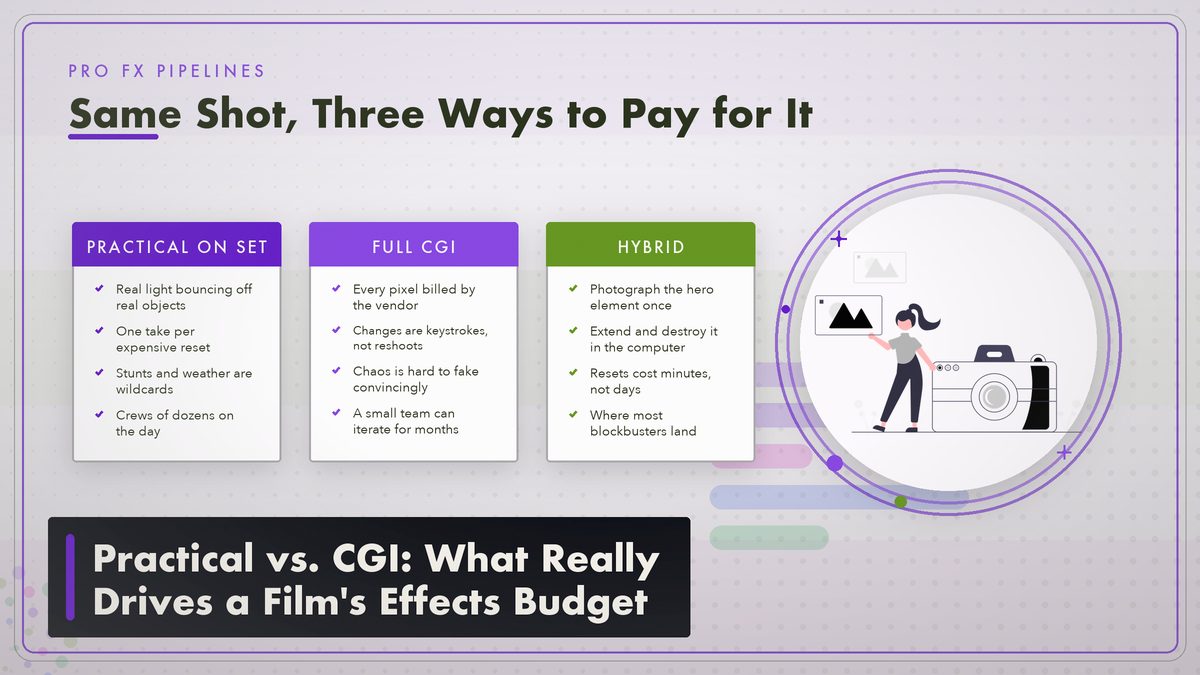
Every effects argument online eventually collapses into the same false duel, with real explosions cast as the heroes and pixels as the villains. The actual question a producer asks is colder than that. It’s also a lot more interesting.
Ask a room of film fans whether a blockbuster should use practical effects or CGI and the opinions come fast. Ask a line producer the same question and you get a spreadsheet. I’ve come to think the fans and the spreadsheet are each right about half the time, which is exactly why the argument never settles. The cost of an effect has surprisingly little to do with whether it was photographed or rendered. What actually moves the money is when it gets spent, who can still change their mind, and how many times the whole thing gets done over.
That framing makes sense of two decisions that look contradictory from the outside. Christopher Nolan crashed a real Boeing 747 into a building for Tenet, while the Matrix sequels built an entire fight out of code and got roasted for it. Both productions spent fortunes. Both made defensible calls. They were simply buying different things, and the sticker price of any single shot hides most of the story.
The Argument Started Long Before CGI
People assume the practical-versus-digital fight began with computers. It didn’t. During the 1930s and 40s, effects departments argued constantly about whether to blow up a miniature in a tank or fake the same spectacle with process photography and a matte painting, and the trade-offs were already familiar to everyone in the room. Miniatures gave you real light and real water, plus debris you could film from any angle, but you could destroy them only once. Painted and projected illusions could be revised until the week of release. Swap the tank for a render farm and a commissary conversation from 1940 would sound current, which is part of why the Academy’s Scientific and Technical Awards have honored both optical printers and software tools over the decades.
What changed in the 1990s was the shape of the choice, not its existence. Digital tools stopped being a novelty for logo flyovers and started carrying characters, crowds, even whole environments. The landmark everyone cites is Jurassic Park, and the numbers deserve precision because the myth has drifted. The dinosaurs occupy roughly fifteen minutes of screen time, and only about six of those minutes are full CGI. The rest are Stan Winston’s puppets and animatronics. Spielberg didn’t pick a side. He bought a blend, and that blend is why the film still works more than thirty years later.
Studios noticed. So did the effects houses. Industrial Light & Magic, born in 1975 out of George Lucas’s frustration with what Hollywood could build him, went from photographing models to writing render software within two decades, because a practical effect turned out to carry a hidden invoice attached to every decision made after the camera rolled.
What Practical Effects Actually Cost
The part that surprises people who romanticize the old ways is that practical is often the expensive option, and it’s expensive in a very particular way. The money arrives early and all at once. You build the rig, hire the crew, prep the stunt, and then you get your takes. If the wind dies or an actor blinks at the wrong moment, there’s no slider to drag. You reset, and a big reset can eat hours while burning through the perishables: the breakaway glass, the pyro charges, sometimes even the vehicle you just destroyed. One take, in some cases. That’s the deal.
Nolan’s filmography is the cleanest modern example of what that commitment buys. For Dunkirk the production put real destroyers in the water and real Spitfires in the air rather than leaning on digital fleets, because physical objects give actors and cameras something honest to react against. For Interstellar the crew reportedly planted hundreds of acres of corn for the farm sequences and sold the harvest afterward, a story that, if true, makes it the only effects line item I’ve ever heard of turning a profit. (I still can’t decide whether planting corn counts as a visual effects technique or just extremely patient farming.) And the Tenet 747 was a decommissioned airliner the production bought outright, because wrecking a real one proved cheaper than faking a building-sized machine tearing itself apart in pixels. Viewers can tell the difference, and that gut-level credibility is what the extra weeks of prep are actually purchasing.
Cheap, in all of those sentences, needs asterisks. Practical costs don’t vanish. They migrate earlier, into build weeks and rehearsal days that studios have learned to dread, and a single big sequence can tie up a hundred people before one frame is exposed. Cut that sequence in the edit and every dollar of it evaporates. A miniature in the wrong film is a bonfire of cash, whereas a CG shot cut from the same movie is a folder that never got rendered to final quality. Post that one honestly, because the practical crowd prefers not to.
Practical money is spent in public, on the day, where everyone can watch it burn. CG money leaks out one revision at a time.
Mad Max: Fury Road sits in the middle and proves the rule by straddling it. The production wrecked something like 88 custom-built vehicles across the shoot, and the marketing liked to claim that nearly ninety percent of what you see is real. Even that film leaned on digital work to erase safety rigs, extend the desert, and stitch together stunts no single camera position could capture. Real metal flew, and so did thousands of paint-out shots.
One more practical cost hides in the paperwork, and it’s safety. The moment a stunt involves moving vehicles, pyrotechnics, or a performer at height, a production inherits coordinators, medics, fire officers, and insurance premiums that climb with the danger of the gag, plus weeks of meetings nobody will ever see on screen. Those people are worth every cent, and their presence is a big reason stunt work is safer now than it was in the 1970s. Still, it’s a fixed tax on physical spectacle, and digital work doesn’t pay it, which tilts the spreadsheet on anything explosive. Nobody photographs those meetings.
What CGI Actually Costs
Flip the coin and the surprises continue. Digital effects carry the opposite structure, and the flexibility is seductive. No build weeks, no weather, no pyro permits, and no perishable vehicles. Every element survives a reshoot because it never existed physically, so a vendor can move the camera after the fact, relight a crowd, or hand a director forty versions of a creature’s blink to choose from at two in the morning. On paper, that’s freedom.
A vendor’s invoice works differently. VFX houses bid per shot, and a shot’s price is mostly labor: artists at workstations simulating, rendering, reviewing, and re-rendering, with the render farm itself showing up as a very real utility bill at the end of the month. Change one note, say the request to make the fire angrier, and the fire simulation re-bakes overnight. Version nine, please. Directors discovered, sometimes painfully, that infinite flexibility invites infinite notes, and a sequence that a practical-minded production would have locked on set can drift through a dozen billed revisions. Trade coverage from outlets like No Film School has documented the resulting crunch for years, a pattern the 2013 collapse of the venerable house Rhythm & Hues made impossible for the industry to ignore.
Fan forums keep bringing up the Burly Brawl from The Matrix Reloaded as the cautionary tale, and they’re right to. Neo fights a hundred Agent Smiths and you can feel the frame go from flesh to simulation. The problem was never that CG was used. Nothing physical anchored the weight of the bodies, so the brain filed the whole fight under video game, while the first Matrix put a real hallway, real wires, and a properly landed stunt under its digital trickery and the audience bought every frame of it.
Same franchise, different lesson.
None of this makes CG the reckless choice. When a building collapses onto a moving camera or a character ages sixty years inside a single scene, no amount of build-week money produces that image at all. The pixels didn’t get expensive, the permission to revisit them did. And for shots like those, the computer is the only door into the scene.
The Hybrid Sweet Spot
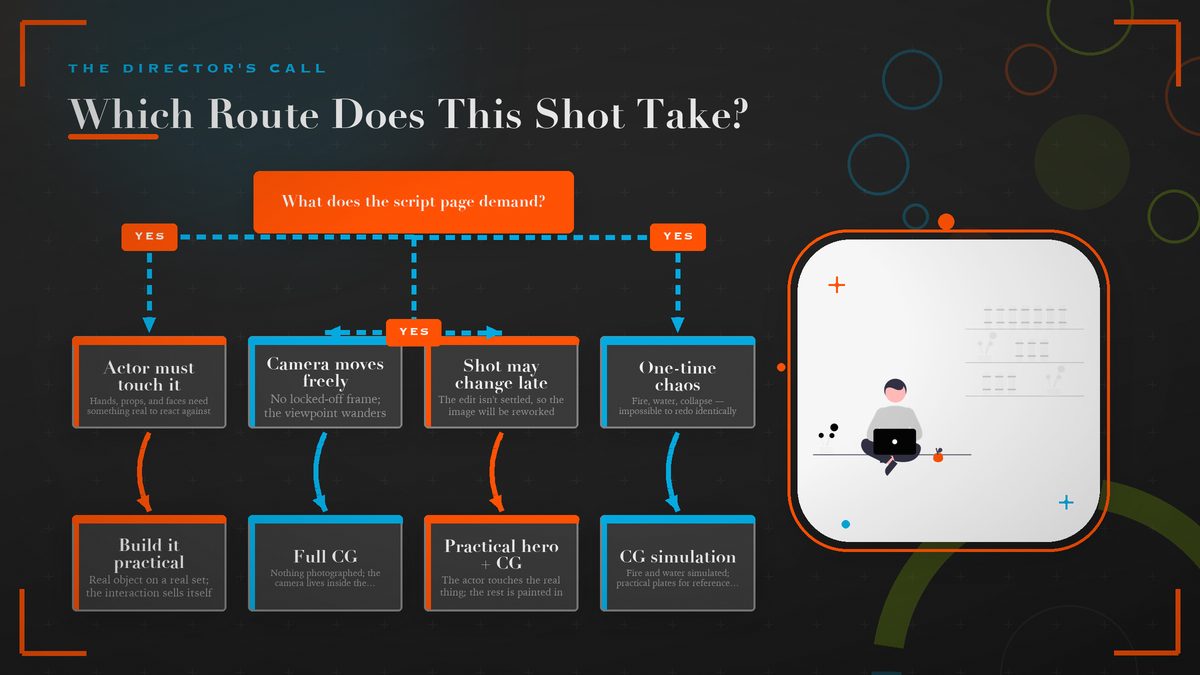
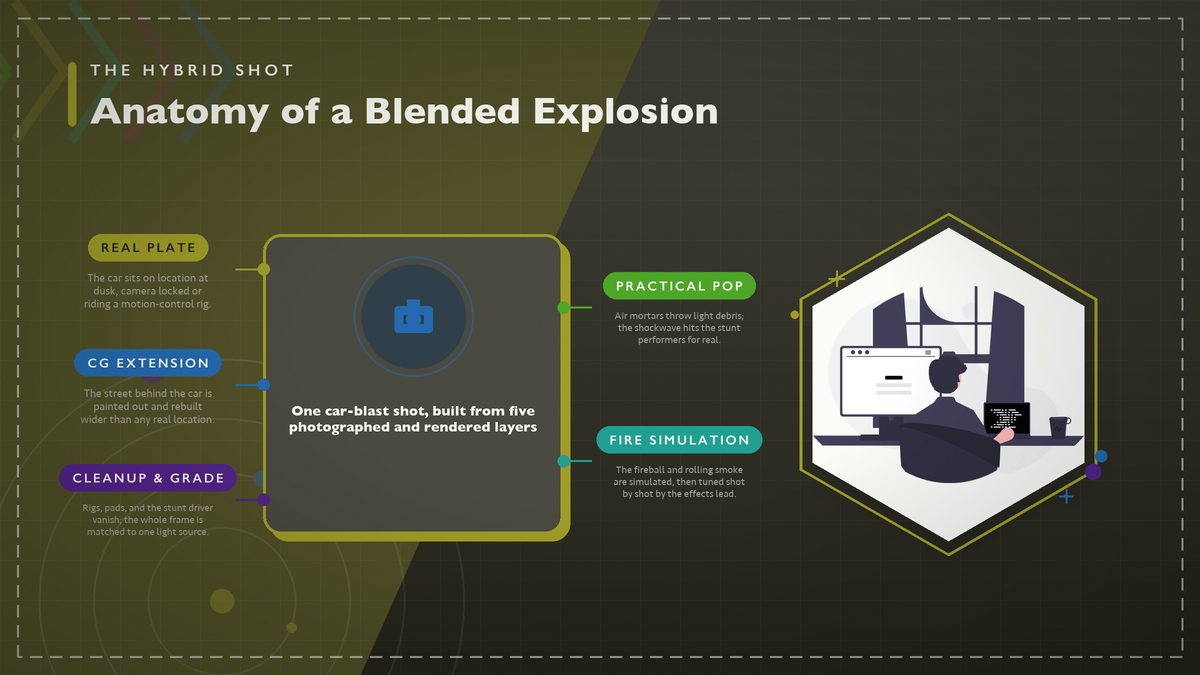
Which brings us to where blockbusters actually land, nearly every time. A hybrid spends practical money only where the camera can see it and digital money only where physics would charge a fortune, and the recipe barely changes from decade to decade. Photograph a real object, a real actor, or a real patch of destruction, then let CG extend the frame around it, delete the machinery that made it possible, and add the elements that would have put someone in the hospital.
James Cameron ran this play on Titanic more than twenty-five years ago. The ship was photographed as enormous miniatures in a tank, because real steel and real water gave him light behavior no 1997 computer could fake, while the crowds on deck, the water where it mattered most, and the long money-shot vistas were all digital. Scale came from the models and flexibility came from the computers. The template hasn’t aged, and the film took home the visual effects Oscar in a year when the phrase CG movie still sounded like a dare.
Blade Runner 2049 repeated the trick in 2017 with far better tools. Weta built and photographed large miniatures of the Los Angeles sprawl, digital teams layered atmosphere, vehicles, and impossible architecture on top, and Villeneuve ended up with a city that feels inhabited because the light in the miniature photography bounces off real surfaces while CG handles all the geography no machine shop could ever construct. Earlier I said hybrids were mostly about money, and they’re. The bigger payoff, though, is that an audience who can’t find the seam stops auditing the effect, and an unaudited effect is the only kind that reads as magic on screen.
Where the Money Actually Goes
Strip away the ideology and the comparison looks like this. Neither column is cheap, and anyone selling either route as a universal bargain is selling something.
| Question | Practical answer | CG answer |
|---|---|---|
| When is the money spent? | Before and during the shoot, all at once | Across months of post, in installments |
| Can it change after filming? | Almost never without reshoots | Constantly, which is both the gift and the trap |
| What happens if the shot is cut? | The build cost is gone for good | Work stops; unrevised shots were never finished |
| What does it give the actors? | Something real to react against | Tennis balls and faith |
| What does it give the camera? | Honest light and physics, one shot per reset | Unlimited angles, endless iterations |
| Where does it fail visibly? | Scale limits and safety rails | Weight, skin, unplanned chaos |
The table has a glaring hole, of course. It treats each route as a pure choice, and purity is the one thing a smart production avoids. So the last row of any real budget meeting always comes out as some version of photograph the hero and fake the rest.
The Change-Order Multiplier
Underneath all of this sits a pattern that deserves its own section, because it’s the single biggest cost driver in modern effects and almost nobody outside the industry talks about it. Work done early is cheap to change; work done late is dear. A shot adjusted in previsualization costs an afternoon. The same note on a shooting day can burn a full crew with equipment rentals ticking. The same note in post costs a vendor team a week. And the same note after picture lock costs enough that someone schedules a meeting about whether the note was truly that important.
CG didn’t invent this multiplier, but it supercharged the permission to use it. A director who would have committed to one practical explosion on set, once, forever, can now request version nine of a digital one at eleven on a Sunday night, and somebody has to render it by morning. The studios that budget well are rarely the ones buying the fanciest simulations. They’re the ones forcing notes to land early, while the shot still lives in an animatic instead of on a farm, because a note caught in previs costs an afternoon of one artist’s time, while the same note caught after delivery can mean rebuilding a simulation whose files don’t even open anymore, and nobody rents a render farm out of nostalgia.

The flip side deserves equal time, because the anti-CG crowd skips it. Practical work has a harsher multiplier hiding in it. It’s why veteran stunt coordinators rehearse a gag on video with borrowed props for weeks before anyone books the location, spending small money over and over so the big money moves exactly once. A badly planned stunt doesn’t get nine versions; it gets one, and if that take’s unusable the sequence may die in the edit entirely. CG’s endless revisions look wasteful next to a perfect single take, but most productions aren’t chasing one perfect take of one impossible thing. They’re herding a thousand ordinary shots through an unforgiving schedule, and under those conditions billable flexibility beats heroic inflexibility more often than the romantics want to hear.
What This Means for Your Own Shots
At the hobbyist or short-film level the studio math inverts, and this is the good news. Practical effects at small scale are honestly cheap. A sugar-glass bottle costs pocket change, a friend with an air cannon built from plumbing parts can throw debris all afternoon, and your kitchen light plus a fog machine covers more atmosphere than you’d guess, give or take. The resets that bankrupt studios cost you, at worst, a hardware-store run. Total outlay, maybe forty bucks. Our guides to breakaway props and DIY atmosphere exist because physics doesn’t check your budget before cooperating.
CG has collapsed in price at the low end even faster. Blender is free, and compositing software that once demanded a five-figure workstation now runs happily on a decent laptop, which means the hybrid approach stopped being a studio privilege somewhere along the way. Photograph your actor against a real wall, extend the wall in Blender, add one simulated element, and you’ve executed the same strategy that built Titanic, minus the tank. Our first-composite walkthrough covers the whole pipeline if you want the step-by-step.
So when a trailer restarts the old argument in your group chat, skip the tribal part and ask the spreadsheet questions instead. When does the money move. Who gets to change their mind, and how late. How many times will this get done over. Those three answers, worked through shot by shot, are the whole difference between a production that controls its effects budget and one that gets controlled by it.
Sources & further reading: Industrial Light & Magic, Weta FX, and American Cinematographer, plus the Academy Sci-Tech Awards and the Wikipedia overviews of practical effects and visual effects. Coverage of effects-industry labor and revision culture via No Film School. All links verified live as of October 2026. Related reads on this site: the modern CGI pipeline breakdown and how blockbusters plan effects shots with previsualization.