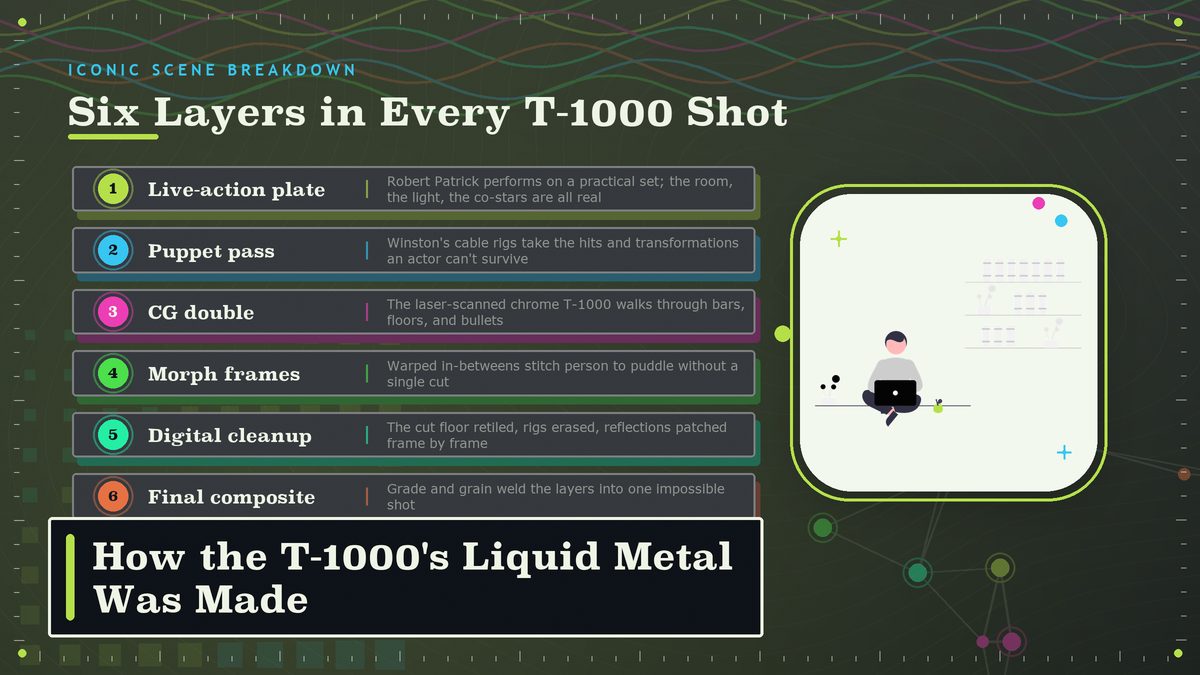
How the T-1000 Liquid Metal Effects Were Created in Terminator 2
In the summer of 1991 a chrome police officer walked out of a puddle of himself and straight into film history. Here’s how puppets, prosthetics, and some of the earliest character CGI ever attempted pulled it off.
There’s a moment in Terminator 2: Judgment Day where the villain rises up out of a black-and-white checkered floor, and for a split second your brain refuses the whole idea. Not because it looks fake. Because it doesn’t look like anything you’ve seen before: a man made of liquid metal reassembling himself from a puddle, every surface mirroring the room like mercury given a badge and a mission. That character, the T-1000, ran on roughly forty shots of computer graphics in a movie with hundreds of effects shots. Almost everything else you remember about it was rubber, steel, and paint. The genius is how completely those two halves hide each other.
James Cameron handed Industrial Light & Magic a problem nobody had solved in 1989, when the script was doing the rounds: a main character that could turn into anything it touched, on screen for long stretches, sharing scenes with real actors under real light. Two workshops ended up splitting that problem in half (ILM up in San Rafael, Stan Winston’s crew down in Los Angeles) and each beating its half separately. Then they welded the results together so smoothly that audiences mostly couldn’t tell you which half they’d been watching.
The Problem Cameron Handed ILM
Read the script’s description and you can feel the trap closing. The T-1000 is a “mimetic polyalloy” machine that samples what it touches and becomes it: a floor tile, a barred door, the person standing in front of you. It flows through gaps a finger wide, flattens itself into linoleum, grows blades where fingers should be. Practical effects had answers for some of that, but no traditional toolbox had all of it. And nobody had ever asked a computer-generated character to carry dialogue scenes.
Graphics had flirted with characters before. The stained-glass knight in Young Sherlock Holmes (1985) lasted about thirty seconds. Pixar’s Tin Toy took home an Oscar in 1988, sure, but that’s a short film where the makers control every pixel. A CG creation had never been trusted as a lead presence in live action, standing next to Arnold Schwarzenegger and selling the scene on equal footing. Dennis Muren, ILM’s visual effects supervisor (the shop George Lucas founded back in 1975, off the back of the first Star Wars), said yes anyway. The team’s final count is usually given as 42 computer-generated shots. That number matters later, so hold onto it: forty-two, in a two-and-a-half-hour movie. It’s almost nothing.
Forty-two CG shots. That’s the entire digital half of the most famous liquid metal ever put on film.
So the plan became a rationing exercise. Spend those forty-two shots only where nothing else could live: the flows, the shatters, the walking through solid matter. Build every other moment out of physical effects the audience could practically reach out and touch. Two teams, two toolboxes, one character.
Stan Winston Built the Physical Half
If you remember the T-1000 turning its forearm into a knife, or its head splitting open into a crowbar that pins a guard to the wall, you’re remembering Stan Winston’s workshop, not a render farm. His crew built a whole family of physical duplicates of Robert Patrick’s character, and each one was engineered for a single gag. A rod-and-cable puppet handled the arm transformations. Breakaway head casts split apart on cue and snapped back together. Rigid chrome-painted stunt bodies took the abuse whenever the machine had to be dragged, dropped, or run over and behave like solid metal rather than soup.
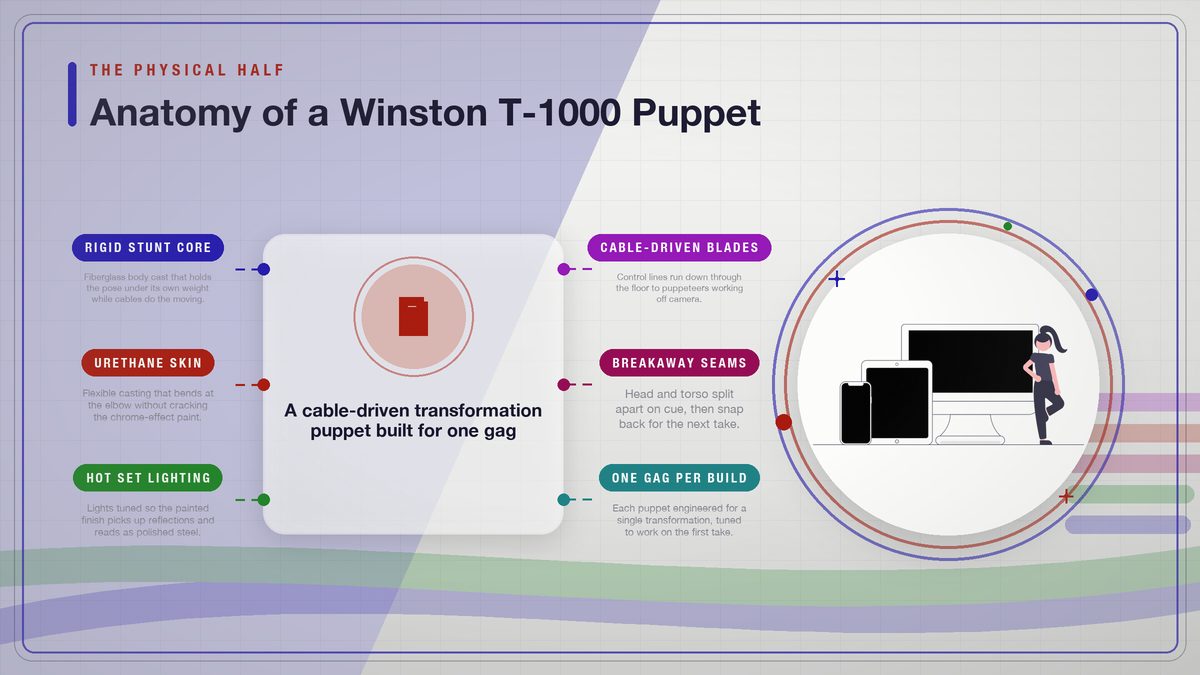
What impresses me most is the restraint. Winston’s people could fake a transformation on camera and sometimes did, letting a well-timed cut hide the swap between Patrick and a puppet. But they never asked one prop to do two jobs. Each build was a one-trick machine, tuned so the trick worked on the first take. That wasn’t perfectionism so much as arithmetic, because when a transformation means a metal arm swinging inches from an actor’s face, retakes are not a thing you get many of.
And it did survive. Watch the hospital-corridor scenes again and notice how much of the T-1000 is simply Robert Patrick moving strangely well: the stillness, the head tilt, the way he goes from statue to full sprint with nothing in between. Patrick reportedly studied predatory animals and decided the machine would never waste a motion. It’s a creative call, and it saved the production entire scenes, because the more convincing the actor, the fewer shots needed anything beyond him.
Teaching a Computer to Be Robert Patrick
The digital half started with measurement. To make CG that could share a frame with Patrick, ILM first needed Patrick inside the computer, and the method sounds like science fiction for 1990: the actor sat for a laser scan (by most accounts a Cyberware scanner of the era) that swept his head and body into a cloud of points a modeler could rebuild in 3D. From that data, artists constructed a digital double with the same cheekbones, same ears, same close-cropped hair. Useful motion capture barely existed, so animators keyframed every CG movement by hand, poring over footage of Patrick until the walk stopped reading as a puppet and started reading as a man with somewhere to be.
Then came the surface, which was the real mountain. Liquid metal has no color of its own. It’s a mirror, bouncing the room back at you. Getting a 1991 renderer to fake that meant painting or photographing environment maps for each location and teaching the software to bend those reflections across an animated face. It worked. It also wasn’t fast; production accounts describe render times in hours per frame, on hardware ILM reportedly kept having to buy more of as the deadline bore down.
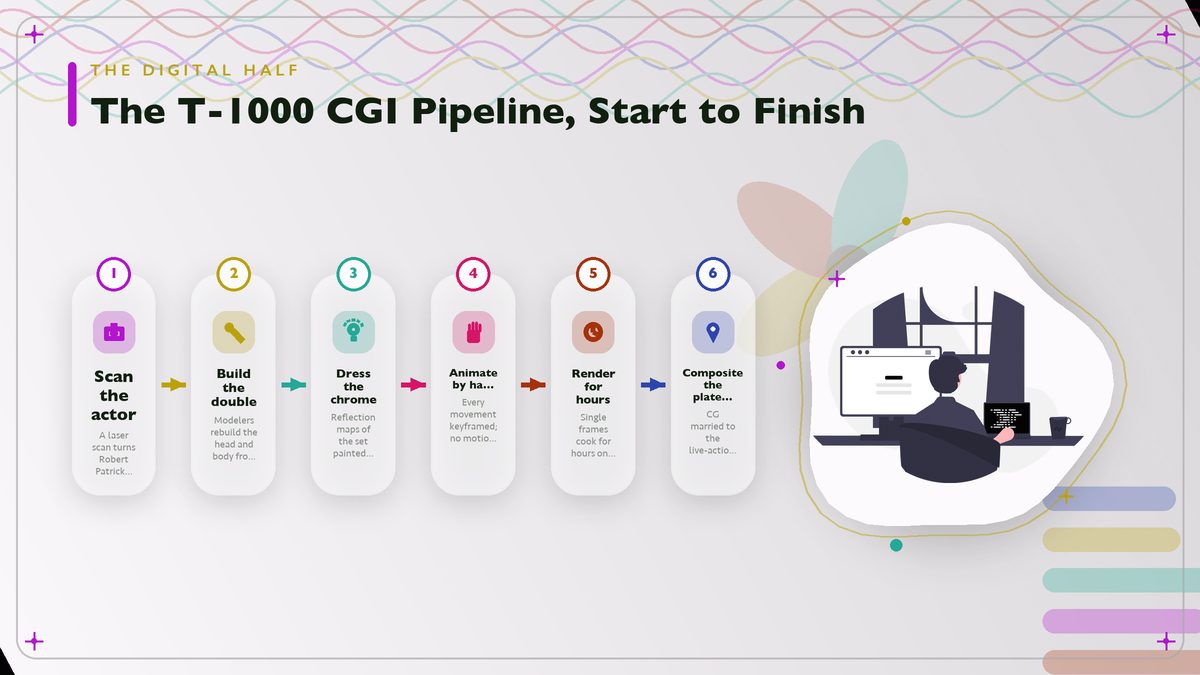
The payoffs were the shots no puppet could touch. That floor-rise you remember was a real floor with a gap cut into it and Patrick rising on a rig; the tidy black-and-white tiling you see afterward is ILM’s, digitally patched so the hole never existed. Cheap, physical, finished with a few dozen frames of CG you were never supposed to clock. The pattern repeats all through the film: do everything practically that you can, then spend the expensive pixels erasing the seams.
The Morph Made the Movie
Between puppet and pixels sat the technique that gave the film its signature transitions. Morphing (dissolving one image into another by warping both toward common shapes in between) had already dropped jaws in Ron Howard’s Willow (1988), where ILM turned a goat into a run of other animals in a single unbroken shot. For T2 the team promoted the idea from stunt to vocabulary. A morph isn’t a crossfade: the software finds matching points on the two images (an eye corner, a collar tip) and flows the pixels from one shape into the other, so a person can become a puddle and the puddle can become a person without a cut anywhere.
It’s the connective tissue of the entire illusion. Puppet footage morphs into Patrick. Patrick dissolves into a chrome man. The chrome man shatters into droplets that scatter across the floor and climb back into a boot. Take morphing out and you’d still have very good effects, but they’d be strung together with jump cuts; with it, the T-1000 reads as one continuous substance that happens to sometimes look like a cop. Honestly, audiences felt the effect before they could name it, which is why “liquid metal” became the phrase everybody reached for on the way out of the theater.

Notice how the labor got distributed, because it’s the reverse of what a lazy production does. CG was the slow, costly, risky option, so it got rationed like film stock during the war years. Puppetry and prosthetics (quick, cheap, and totally convincing in the moment) did the bulk of the work, even inside a $100-million blockbuster. If you’re picking effects techniques for your own project, that’s the lesson sitting in plain sight: point the weird expensive tool only at the shots where nothing else can survive.
Five Shots, Five Tricks
Pull five of the most-quoted moments and the whole strategy plays out in front of you, one scene at a time.
| Shot | What you see | How it was really done |
|---|---|---|
| Floor rise | The T-1000 pours up out of the checkered tiles | Real floor, cut gap, Patrick on a rising rig; ILM retiles the floor digitally after he clears it |
| Through the bars | The machine walks straight through a barred hospital door | Patrick performs the walk; CG splits his body around the bars mid-stride |
| Helicopter stabbing | The pilot’s head splits into blades | A Winston puppet and duplicate cockpit, composited to sit in the real helicopter chase |
| Steel mill shatter | The frozen T-1000 breaks into mercury droplets | Fully CG — one of the rationed 42, and among the most complex frames ILM had ever rendered |
| The thumbs-up | A chrome hand sinks into molten steel, thumb held high | A sculpted chrome-finished hand rig, shot practically in the foundry set |
Only one of those five is pure CG, and even it lands inside a sequence stuffed with real sparks, real steel, and a real Arnold dangling over actual heat. The digital shots were never asked to carry a scene alone. They did the one impossible thing, inside an otherwise tangible room, exactly where early 1990s CG looked its best.
The Night It Paid Off
At the 64th Academy Awards in March 1992, the film took home the visual effects Oscar, and the consequences were already rolling. Two years on, the same shop built the Jurassic Park dinosaurs, a project that only got its green light on character CGI because T2 had proven the bet. The forty-two shots became a license, and the license became an industry. Every morph in a ’90s music video, every digital double sharing a frame with an actor, every practical-plate-plus-digital-finish pipeline in modern blockbusters runs on ground this film broke with puppets and paint.
Here’s the thing I keep coming back to: the effect that aged best isn’t a CG shot at all. It’s the chrome hand sinking into the steel, thumb held up. A sculpted prop, a foundry set, and a deliberate choice to end the machine with something you could reach out and touch. Thirty-five years on, it still lands, and I’d argue it’s because the audience was never really grading the technology. They were watching a story about a machine learning to be human, told by tools that had to learn the same lesson.
Next time the T-1000 walks through the bars, try to catch the exact frame where Robert Patrick stops and the render begins. You’ll fail. And that, more than the Oscar or the render hours, is the trick.
Sources and further reading: the film’s Terminator 2 and T-1000 reference pages, ILM’s company history, Stan Winston’s biography, and the morphing technique overview. Shot counts and production details reflect commonly cited figures from production histories.