Bullet Time, Explained: The Camera Rig Behind The Matrix
A federal agent fires at point-blank range. Neo bends backward, impossibly slow, while the camera swings around him in a smooth arc that no crane could fly. The trick took a wall of ordinary still cameras, a pile of math, and the nerve to build a moving shot out of photographs.
Nobody who saw The Matrix in 1999 sat still during the rooftop scene. An Agent empties a pistol at Neo, and instead of cutting to a reaction shot, the movie does something that felt illegal: time thickens to syrup, the camera detaches from the world, and we glide in a perfect circle around Keanu Reeves as his torso folds away from bullets that crawl past his chest like raindrops on glass. Directors had frozen time before. They had flown cameras before. Nobody had done both in the same breath, and audiences walked out of theaters trying to explain what they’d just seen. Mostly they were wrong. It wasn’t high-speed photography, and it wasn’t a computer moving a virtual camera. It was, of all things, still photography. An old idea pushed past its limit.
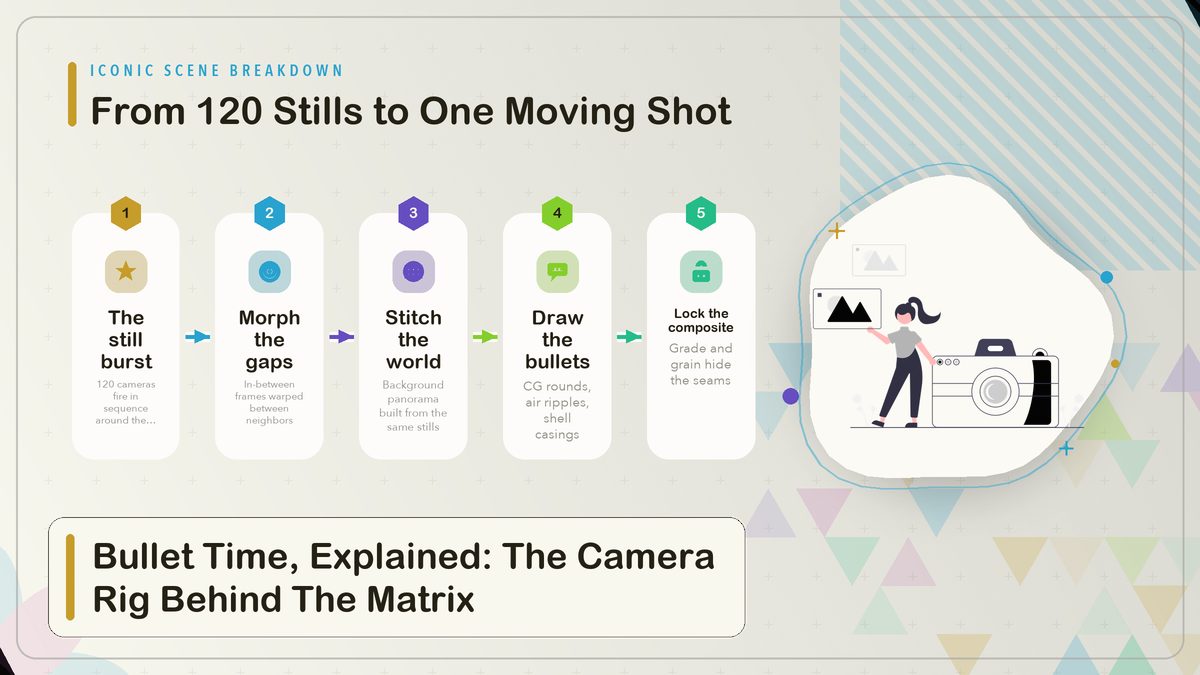
The short version, which the rest of this breakdown earns: the dodge was made with a rig of roughly 120 still cameras arranged in an arc, each one firing in sequence around the actor. Every camera froze the same instant from a slightly different angle. Software then morphed between those frozen instants to invent the in-between frames, stitched a background out of the same stills, and laid computer-generated bullets on top. A moving camera built out of photographs. Once you know that, the shot gets better, not worse.
What You’re Actually Watching
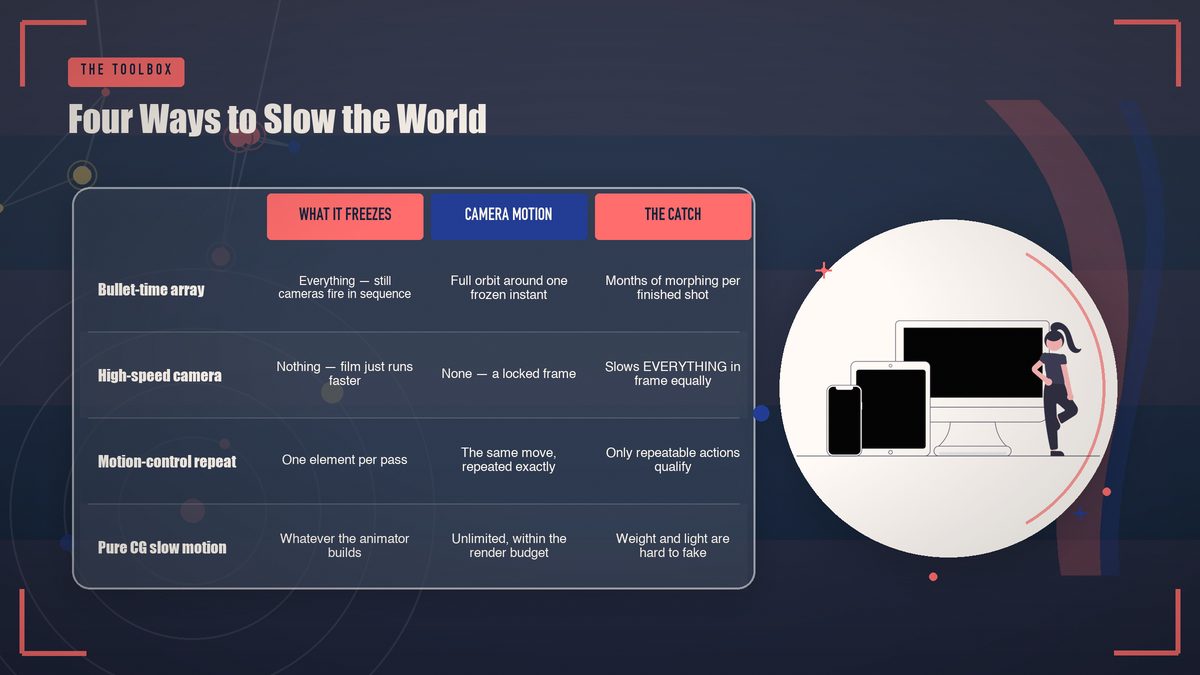
Strip the shot down and there are three illusions running at once, which is why it short-circuited so many brains in the theater. The first one is temporal: the bullets cross the frame in slow motion while Neo’s body responds at something closer to normal human speed, and that mismatch is the entire spell. You can’t shoot it with a high-speed camera, because a high-speed camera slows down everything in front of it equally. The spatial illusion is sneakier. The viewpoint orbits the subject, a camera move that would need a crane swinging through the set at lethal speed while the world stands still. And then the material lie: the bullets themselves are CG, glinting and rippling the air, added in post because no prop department stocks ammunition that travels at a walking pace.
Director of photography Bill Pope and the Wachowskis wanted all three at once. The crew at Manex Visual Effects, supervised by John Gaeta, got there by refusing the obvious tools. Don’t slow the film down. Don’t move the camera mid-shot. Freeze the world completely, move the viewpoint one photograph at a time, and let the edit between frames stand in for the passage of time. The concept is so counterintuitive that even now, a quarter century on, people assume it was a render-farm effect.
Bullet time isn’t slow motion and it isn’t a CG camera. It’s a wall of ordinary still cameras, fired in sequence, with the motion invented afterward by software.
A Hundred Years of Warm-Up
The Matrix didn’t invent the idea so much as cash a check photography had been writing since 1878. That was the year Eadweard Muybridge lined up a battery of cameras along a racetrack to settle a bet about whether a galloping horse ever has all four hooves off the ground. His tripwires fired each shutter in turn, and the resulting strips of stills didn’t just win the bet. They invented motion analysis. Muybridge proved that if you place many cameras along a path and fire them in order, time and viewpoint trade places: a moving subject becomes a moving camera. Every time-slice rig since, including the one on that rooftop, is Muybridge’s racetrack with better electronics.
The modern version of the trick was already floating around the effects community in the early 1990s, usually under the name “time-slice.” Commercial director Michel Gondry had played with frozen time in music videos, and a rig called TIMEMACHINE, built by cinematographer Dayton Taylor, fired rings of still cameras for a now-famous 1996 Smirnoff vodka commercial. What Gaeta and Manex added wasn’t the concept. It was the interpolation. Earlier time-slice looked like a slideshow, a hard cut from camera to camera, because nobody could invent the missing frames. The Matrix made the arc continuous, and the continuity is what made it feel like a camera move instead of a flip-book. Gaeta has always been generous about the lineage, and the history of bullet time runs in a straight line from a racetrack in Sacramento to a soundstage in Sydney.
The Rig: About 120 Cameras in a Line
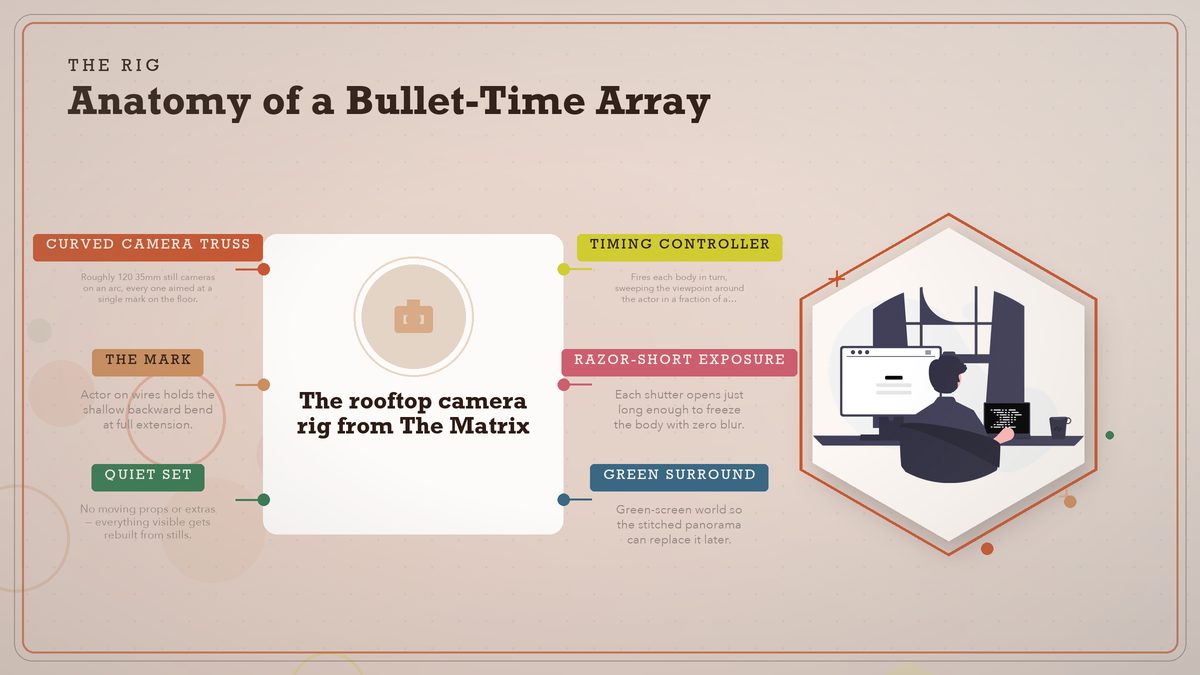
Picture a green-screen rooftop set in Sydney, because that’s where it was. On one side, a curved truss carrying rows of 35mm still cameras, roughly 120 of them for the big arc, every one aimed at a single mark on the floor. Keanu Reeves stands on the mark, hooked into wires so his body can hold the shallow bend backward. When the cue comes, the computers don’t take a picture. They take 120, one after another, sweeping around the actor in a fraction of a second. Each exposure is razor-short, fast enough to freeze Reeves mid-pose with zero blur. That’s why the finished shot has that eerie, hyper-sharp look slow-motion film never gets.
A few engineering details do quiet heavy lifting. The cameras sit close together because wide spacing means bigger gaps to morph across, and big gaps are where faces melt. The rig is curved rather than circular so the viewpoint stays the same distance from the actor, keeping his head size constant as the arc sweeps; nothing betrays a cheat faster than a swelling head. And because the cameras are stills, not cine cameras, the crew can use cheap bodies and short, sharp lenses, then worry about the background later. That last part matters more than it sounds.
From 120 Stills to One Impossible Move
This is the part that separated 1999 from 1996. A bullet-time shot produces maybe a few dozen real photographs per second of finished footage. Play them back raw and you get a stuttering flip-book, each cut jarring because adjacent cameras disagree about tiny things: a finger millimeters higher, a jacket fold in a new position. Manex’s artists fixed it with morphing, the same software family that made faces melt in music videos, here turned to disciplined, frame-by-frame alignment. Corresponding points get marked across neighboring photos (corner of an eye, tip of a collar), and the computer generates the in-between image by warping one photo toward the next. Do it 120 times around an arc and the flip-book dissolves into a glide.
The background had to be invented too. A still camera sees one angle of one moment, but the finished shot reveals the whole rooftop as the viewpoint swings, so the crew built panoramic backdrops by stitching the array’s own stills together and extending them with CG versions of the set. You can spot the giveaway if you look for it. The world in a bullet-time shot never contains genuine moving elements: no fluttering cloth on a line, no passing traffic, nothing alive. Everything that moves is either the subject or something drawn in afterward. The bullets, the air ripples, the shell casings drifting off the pistol. All CG, composited last.
Everything that moves in a bullet-time shot is either the actor or something painted in afterward. Watch a rooftop background closely: you’ll never catch a real moving object.
Anatomy of the Rooftop Shoot
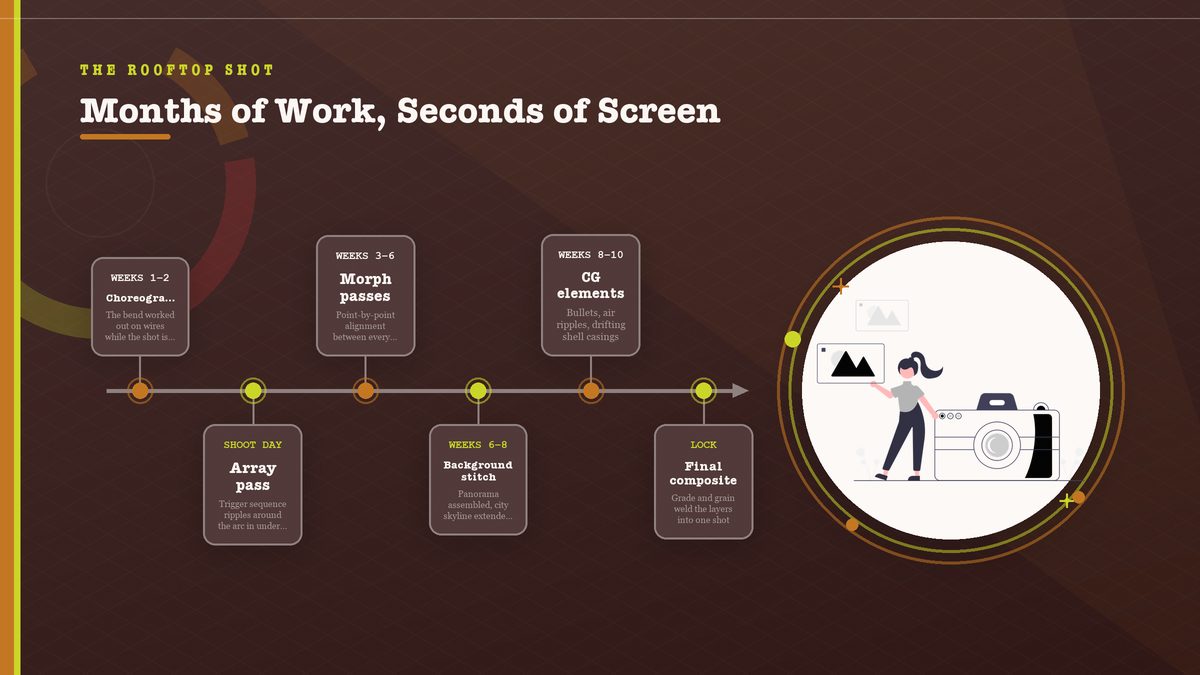
Put the pieces in order and three seconds of screen time turn out to be a production pipeline in its own right. The choreography came first. Reeves and the stunt team worked out the bend on wires while the shot was still a storyboard, because the pose had to be holdable at full extension for long stretches while cameras were aligned. Then the array pass itself: the trigger sequence rippling around the arc in well under a second. What followed was the unglamorous majority of the work, weeks of morph supervision, point-by-point alignment, background stitching, and bullet animation, with render times per finished second that Gaeta’s team measured in days.
The whole sequence, start to composite, ran to months for a handful of shots. Money well spent, in the way Hollywood understands: at the 72nd Academy Awards, The Matrix took the visual effects statue for Gaeta, Janek Sirrs, Steve Courtley, and Jon Thum, alongside its wins for editing and both sound categories. The film later entered the National Film Registry in 2012, bullet time explicitly cited among the reasons it qualified as culturally enduring.
Why Everything After 1999 Looks Like This
The strangest thing about bullet time is how fast it stopped being strange. Within two years the effect was everywhere: car commercials, music videos, sports broadcasts. Video games went furthest. Remedy’s Max Payne built its whole identity around a playable version of the shot. Hit a button and the game world drops to bullet speed while your aim stays human, and suddenly a camera trick from an art-house action film was a mechanic twelve-year-olds were mastering. The name stuck so hard that “bullet time” became the generic term, and the film’s long shadow falls across everything action-adjacent since, from 300’s speed ramps to the suspended-camera gymnastics of modern superhero landings.
And here’s the irony the sequels hang on. For The Matrix Reloaded and Revolutions, the team largely abandoned the physical rig in favor of “virtual cinematography”: actors photographed from every angle with dense camera arrays, bodies digitized, viewpoints rendered purely in CG. The rooftop shot’s DNA, freeze the subject and free the camera, survived. The cameras did not. Purists missed the stutter of the real thing. Honestly, so do I. There’s a crispness to genuinely frozen photography, a texture of the real, that fully synthetic viewpoints took years to fake convincingly.
What Makers Can Steal From This Shot
You can build a toy version of this rig with gear from a pawn shop, and people do, every year, for less than the price of a decent lens. The rooftop scene’s lessons scale down to fan films and cosplay reels almost intact:
- Freeze everything, move the viewpoint. Temporal and camera motion are the same knob on this rig. If your subject holds still, a line of cheap stills cameras fired in sequence gives you an orbit no gimbal can fly.
- Space the cameras tight. Morphing bridges small gaps gracefully and big gaps hideously. Twice as many cheap cameras beats half as many good ones. Every time.
- Invent the background separately. Stills want stitching; plan your set knowing that everything visible will be reconstructed from photographs or painted. No moving props in frame.
- Draw the fast things in post. The bullets were CG because real ones couldn’t perform. Whatever violates physics in your shot (muzzle flash, smoke ring, water splash) is cheaper drawn than photographed.
- Budget for the tail, not the shoot. The array pass took under a second. The compositing took weeks. Price your project by the frame-count of finished footage, not the day-count on set.
One more thing worth stealing is the attitude. The Manex crew didn’t have a “make bullet time” button. They had still cameras, morphing software built for face melts, and a director pair who refused to pick between slow motion and a moving camera. The shot exists because someone stacked a hundred-year-old idea next to a five-year-old tool and asked what the combination could do. That’s the actual craft on display, and it never required a Hollywood budget. Just nerve.
So re-watch the rooftop scene knowing the machinery. The arc is a hundred frozen instants holding hands. The bullets are drawings. The stillness of the world is a set dressed for photographs. None of that diminishes the shot. It’s why the shot still lands, decades later, every time it plays.
Sources and further reading: the technique’s lineage runs from Muybridge’s 1878 motion studies through early-90s time-slice work to Gaeta’s team at Manex; awards and cultural-recognition details come from the Academy’s official ceremony record and the Library of Congress National Film Registry. External links were checked live at publication time. Internal follow-ups on this site will cover the Inception hallway rig, the T-1000’s morph effects, and how motion capture suits actually record a performance.