How the Jurassic Park Dinosaurs Were Made (Before Full CGI)
In 1993 nobody knew if a computer could carry a living, breathing dinosaur. So Steven Spielberg’s crew built one out of steel, hydraulics, and hand-sculpted rubber, and only then, carefully, let ILM’s brand-new CG tools fill in the shots no machine could manage. The result still looks better than most CGI made this decade.
Here’s the dirty secret of Jurassic Park: the dinosaurs barely appear. The film runs over two hours, and by careful count the creatures get maybe fifteen minutes of screen time all told. Those fifteen minutes still rewired an industry, scared a generation of moviegoers out of their seats, and hold up against effects built with tools the 1993 crew couldn’t have dreamed of. The secret isn’t nostalgia. It’s that they solved the problem in the right order: build the animals first, in steel and latex, and treat the computers as a bonus rather than a crutch.
If you’re a film buff, you’ve heard the shorthand: Jurassic Park “started the CGI era.” True, and badly incomplete. What the movie really is, is the last great practical-effects blockbuster ever made, a picture that happened to hand the baton to digital in its final act. Nearly every shot you remember is a physical object, a puppet, a suit, or a blend stitched together so cleanly you never catch the stitch. Learn to tell which is which and the film gets twice as fun. So let’s break down how each technique was built, who built it, and where the seams hide.
The Problem Spielberg Refused to Solve With Computers
The pressure came first. Michael Crichton’s novel triggered a studio bidding war before the book was even finished, and Universal handed Spielberg a budget that, against the scale of the ambition, wasn’t generous. The script called for living, breathing animals. Not monsters, not aliens. Dinosaurs had to move like elephants and ostriches, behave like wildlife, and carry long dialogue scenes on their backs. One second of disbelief and the film was dead.
And in 1993 the obvious answer wasn’t obvious at all, because no digital character had ever carried a live-action film. What existed was stop-motion, the frame-by-frame puppet craft that had thrilled audiences since King Kong in 1933, plus a souped-up descendant called go-motion, which nudged the puppet during each exposure so the frames blurred like real movement. Spielberg hired the undisputed master of that craft, Phil Tippett, the man behind the AT-AT walkers in The Empire Strikes Back and the ED-209 in RoboCop, to animate the dinosaurs go-motion style.
At the same time he hired Stan Winston Studio, the creature shop that built the Terminator endoskeleton and the Alien Queen, to construct full-size, fully animated dinosaurs for the close-ups. That was the plan on paper: real machines for the intimate moments, stop-motion for the wide ones. Then a test reel rewrote everything.
Industrial Light & Magic, the house George Lucas built for Star Wars, had quietly spent years chasing photorealistic computer animation. When ILM screened a wireframe test of a walking T. rex for Spielberg, smooth and heavy in a way go-motion never quite managed, the director made his call almost on the spot. But here’s the part the “CGI won” narrative always skips: he didn’t fire the puppeteers. Winston’s practical creatures kept every close-up, and ILM got only the shots a machine physically couldn’t do. Two rival traditions, one film, chosen shot by shot.
Track One: Stan Winston’s Hydraulic Monsters
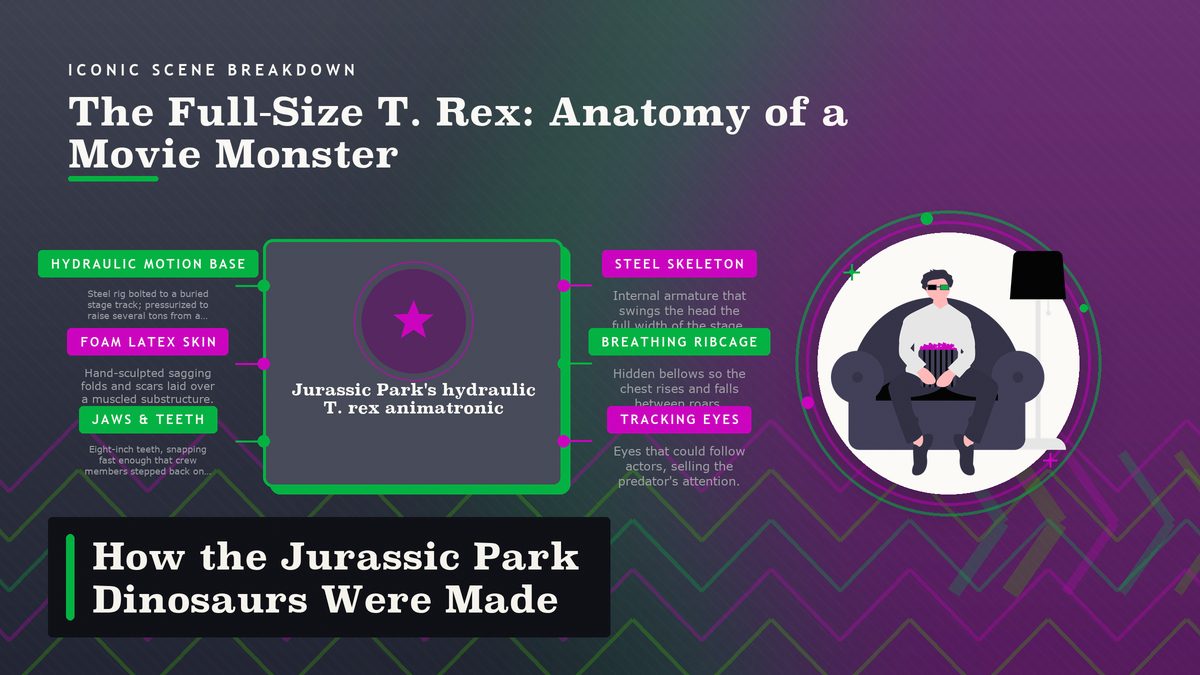
Winston’s crew in Van Nuys, California, arguably drew the harder straw: build machines that can act. Their flagship was the full-size Tyrannosaurus rex, about forty feet long and twenty feet tall at the head: a steel skeleton wrapped in sculpted foam latex, mounted on a hydraulic motion base bolted to a track buried in the stage floor. Several tons of predator. When the hydraulics pressurized, the animal could rise from a resting crouch, swing its head the width of the stage, and snap jaws lined with eight-inch teeth, a motion fast enough, by many crew accounts, that people stepped back the first time it ran.
Nothing that size moves like a puppet. It moves like weather. Hydraulic oil compresses, hoses flex, and tons of steel carry inertia, which is why operators had to lead their cues like drummers, starting a head-swing seconds before the camera needed it. The skin was its own engineering feat: foam latex over a muscled substructure, hand-sculpted with the sagging folds and scars of an old predator. Underneath sat subtler tricks (a ribcage that rose and fell, eyes that could track) because Spielberg’s one commandment was that these be animals, not theme-park monsters. The rain scenes added a hazard nobody had fully planned for. Water kept finding its way into the electronics, and the big rex would occasionally twitch and shiver on its own between takes. Crew members joked that it was coming alive. Honestly, watch the behind-the-scenes footage of it quivering under the rain bars and the joke doesn’t feel like a joke.
Two other builds filled out the practical cast. The sick Triceratops that Ellie Sattler kneels beside in the mud was a full-size animatronic with a breathing belly and a jaw that could be pried open for the “they’re poisonous” gag, engineered so actors could lean their full weight against it. Then there were the Velociraptors. Small enough to build as suits and puppets, they turned into the most convincing creatures in the whole picture: performers in partial raptor suits running on stilt-like “raptor legs,” rod puppets handling the fine head work. The kitchen sequence, two raptors hunting Tim and Lex between stainless steel counters, contains essentially no computer imagery at all. Just suits, puppets, and razor editing.
The raptor kitchen scene runs on almost zero CGI — performers in suits and rod puppets, cut with the confidence of people who knew exactly what they had.
Track Two: ILM’s Fifty Shots
So what did ILM actually get? Far less than the legend says. On the order of a few dozen fully computer-animated shots, adding up to maybe five or six minutes of screen time. The studio had never attempted a photorealistic organic character before, and its artists more or less wrote the workflow as they went: start from Winston’s physical sculptures so the digital and practical animals matched, paint the models with skin textures pulled from photographs of elephant and rhino hide, then render with custom software that faked the soft, subsurface look of living flesh.
The CG showcase moments jump out once you know the signatures. The first dinosaur in the film, the Brachiosaurus rearing onto its hind legs to strip a tree, is pure ILM, and it remains one of the most important shots in cinema history: the first fully digital animal to carry an emotional beat in a live-action film. The Gallimimus stampede blends a live-action plate shot in Hawaii with a digital herd plus digital environment extensions, Grant and the kids flattened against a log as the animals part around them. And whenever the T. rex had to actually run (the Jeep chase above all), the hydraulic machine couldn’t travel, so a CG double took the wide shots, intercut so tightly with the animatronic close-ups that audiences read one animal.
My favorite detail lives behind that blending. Tippett, whose go-motion method had just been displaced, didn’t walk off the production. He stayed on as “dinosaur supervisor,” and his team wired a modified stop-motion armature into the computer, the Dinosaur Input Device, so Tippett could physically perform a dinosaur’s movement by hand and have that performance drive the digital rig. Decades before mocap suits became standard equipment, a stop-motion animator’s muscle memory was flowing straight into CG. The hand never left the process. It just switched instruments.
The Shot List: What You’re Actually Seeing
Fastest way to re-watch the film like an effects nerd: sort the famous shots by technique. Cheat sheet below.
| Scene | How it was done | Why that choice |
|---|---|---|
| Brachiosaurus reveal | Full CGI (ILM) | A gentle giant with no real-world analog to copy, the perfect low-risk first shot for a new technology. |
| T. rex paddock breakout | Full-size hydraulic animatronic + CG wide shots | Close-ups needed eye contact, saliva, and impact tremors in the water glass; CG carried the running. |
| Sick Triceratops | Full-size animatronic | Actors touch it, lean on it, lie against its flank; a physical build was the only option. |
| Raptor kitchen hunt | Performer suits + rod puppets | Tight interior, fast interaction with child actors; puppets gave the camera something real to shadow and reflect. |
| Gallimimus stampede | CG herd in a live plate | Thirty-plus running animals over broken terrain, impossible practically, and the shot that sold the technology to Hollywood. |
| Raptor vs. T. rex finale | Animatronic + CG blend | Two animals fighting at full speed in one frame; the blend hid each method’s limits behind the other’s strengths. |
See the pattern? Technology serves the shot, never the reverse. CG took the impossible wide vistas; hydraulics took the intimate acting; suits took the claustrophobic interior horror. Every method had a weak spot (the animatronic couldn’t run; the 1993 CG couldn’t convincingly touch an actor) and the edit simply hid the joint.
The Sound and the Fury (and the Rain)
Picture was only half of it. Sound designer Gary Rydstrom at Skywalker Sound built the T. rex roar the way a chef builds a sauce: a baby elephant’s bellow as the base, layered with tiger, alligator, and penguin recordings. Then there’s the sound audiences feel before they hear it: the sub-bass thump of each footfall, Rydstrom’s guess at what a forty-ton impact does through the ground. Sound, more than imagery, puts that machine in the theater with you. And it cost a fraction of a single CG shot.
Even the weather was an effects decision. Spielberg shot the T. rex breakout in sheeting rain at night, mostly for mood. But water streaming off the animatronic’s skin did priceless work, washing latex and steel toward the organic and hiding every boundary line. Watch any making-of featurette and the crew is practically cheering the rain machine. Constraints, embraced early, became texture.
Why It Still Holds Up
Ask working effects artists why this film has aged so well and the same few answers come back. First, the practical builds gave the digital team a reference: Winston’s sculptures defined how the CG animals looked, so the two traditions could never drift apart visually. Second, the lighting was real. An animatronic on a set means the set is genuinely lit for a dinosaur-sized object, and the CG shots matching that set inherit a physical coherence green-screen work often misses. Third, maybe the big one: the audience’s attention was rationed. Fifteen minutes of dinosaur across two hours means every appearance lands as an event. The film never spends its creatures cheaply.
Consider the contrast with what came after. Within three years, Hollywood had swung hard toward all-digital creatures, and a lot of mid-90s CGI has the floaty, weightless look of its era because nothing physical ever anchored it. Jurassic Park skipped that phase almost entirely; its CG animals were always cut against footage of a real machine obeying real gravity. The eye calibrates against the practical shots and trusts the digital ones by association. That, more than any rendering breakthrough, is the film’s real technical achievement.
None of this is trivia. The film sits in the Library of Congress National Film Registry as a work of enduring cultural significance, the AFI Catalog documents its production history in detail, and at the 1994 Academy Awards the visual effects Oscar went to the four-way team of Dennis Muren (ILM), Stan Winston (animatronics), Phil Tippett (the go-motion-to-supervision bridge), and Michael Lantieri (on-set mechanical effects). One statue, four men, two rival traditions. The Academy’s official ceremony record made the hybrid the certified future of the craft.
A stop-motion animator’s muscle memory flowed straight into the CG rigs through Tippett’s Dinosaur Input Device — the hand never left the process, it just switched instruments.
What Makers Can Steal From This Film
You’re probably not building a forty-foot hydraulic theropod in your garage (the landlord has thoughts). But the production’s discipline scales all the way down to fan films and cosplay videos:
- Build the close-ups physically. A $40 foam-latex prop three feet from the lens beats a flawless render the audience doesn’t emotionally trust. The camera believes objects that cast real shadows.
- Reserve digital for motion. Use software for what physics won’t let you do (levitation, crowd duplication, impossible camera moves) and keep the rest in the real world. ILM got only the shots hydraulics couldn’t manage. Give your own CG budget the same discipline.
- Design sound before you shoot. Rydstrom’s roar carried as much weight as Muren’s render farm, and sound remains the cheapest effects multiplier any production owns.
- Hide seams with weather and darkness. Rain, night exteriors, and handheld camera weren’t just mood; they were continuity armor for the animatronics. Your limits can become your look.
- Cut for the animal, not around it. Long takes let the audience study a convincing build, while quick cuts telegraph doubt. Spielberg holds on the T. rex for astonishing stretches because the machine could take it.
One more lesson hides in the personnel story. Tippett could have walked when stop-motion got displaced. Instead he built the bridge (literally, the input device) between the analog craft he knew and the digital craft arriving to replace it, and ended up supervising dinosaur movement on the sequels. When a tool changes, the craft doesn’t die. It migrates.
The Bottom Line
Jurassic Park endures because it arrived at the one moment when practical effects had fully matured and digital effects had just become viable, and Spielberg, with Winston, Muren, Tippett, and Lantieri, had the discipline to use each only where it was strongest. The dinosaurs feel real because, more often than not, something real stood in front of the camera. Everything else was earned one honest shot at a time.
So re-watch it with this breakdown open. The stampede becomes a live plate with a digital herd dropped in. The kitchen turns into an elegant puppet show. The breakout splits into two different T. rexes trading the screen without ever breaking character. That’s the trick, and once you see the machinery, you respect it more, not less. The best special effects have always worked exactly that way.
Sources and further reading: the production is documented in the AFI Catalog and the Library of Congress National Film Registry; creature-construction details come from Stan Winston School’s published material; ILM’s role is covered by the studio’s own site and awards records. External links were checked live at publication time. Internal follow-ups on this site will cover the T-1000, bullet time, and modern pipeline breakdowns.