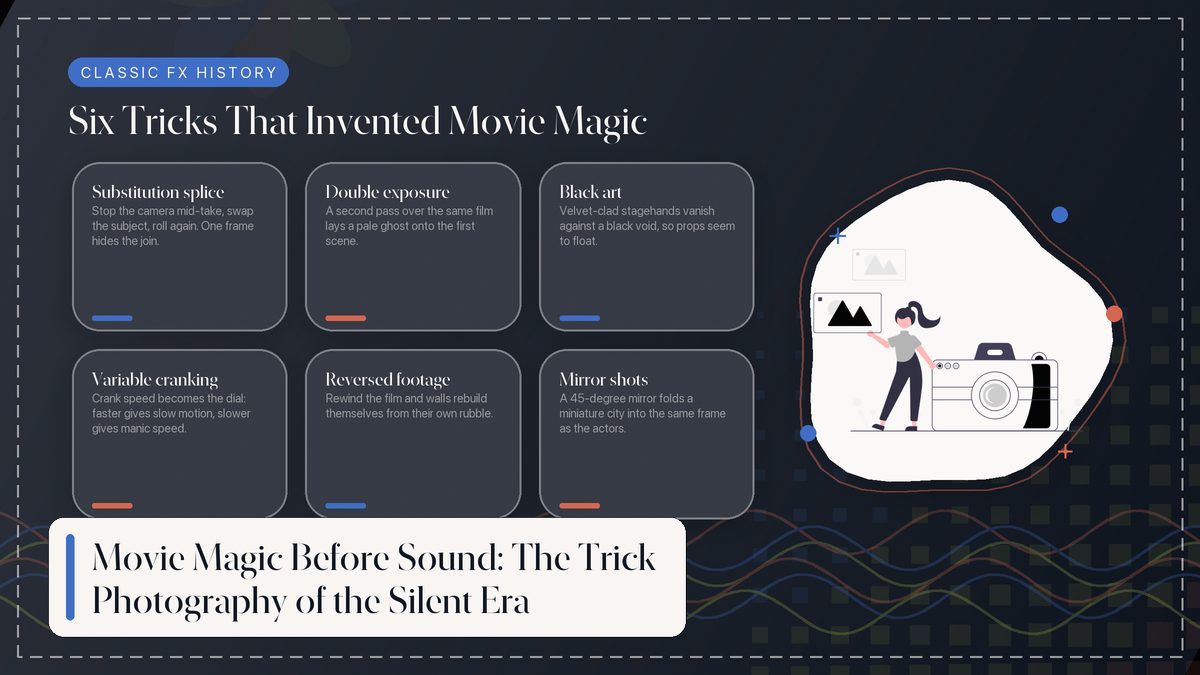
Long before green screens and render farms, filmmakers were already making people vanish, ghosts walk through walls, and cities burn, using nothing more than a hand-cranked camera and a willingness to lie to the audience. Every one of those tricks still works today.
Watch a movie from before 1930 and you expect the limitations: no spoken dialogue, no color, jerky motion when somebody runs. What you don’t expect is a man plucking off his own head and playing catch with it, or a ghost stepping clean out of a sleeping body and strolling away. Filmmakers were doing stunts like that by 1898, barely three years after the first public screening. I’d argue the silent era invented more of the visual-effects toolbox than the fifty years of computer graphics that followed, because almost everything we now do in software, they first worked out inside a camera that contained no electronics whatsoever. Not one.
The center of that story is Georges Méliès, the French stage magician whose career the standard film histories document in detail. He ran a magic theater in Paris and bought a camera in 1896. Then he spent the next twenty years turning it into a prop. He wasn’t alone, and this isn’t only his biography. But he’s the right place to start, because he handled a film camera the way a magician handles a trick deck of cards, as a device whose single job is making an audience believe something impossible just happened in front of them, an attitude that shaped every trick in this article.
A Magician Notices the Camera Can Lie
His venue was the Théâtre Robert-Houdin, a proper stage-magic house, at the moment the Lumière brothers held their first public film screening in December 1895. He tried to buy a camera from them, got refused, and bought an animatograph from the British engineer Robert W. Paul instead. Within a year he was shooting little films between magic shows, and by his own oft-retold account, his career as a film-trick inventor began with an accident on an ordinary Paris street.
He was filming traffic when the camera jammed. By the time he got it cranking again, the vehicles had moved on, and when the developed film played back, a bus had turned into a hearse. It was instantaneous. The substitution looked like sorcery on screen. Méliès understood at once that he’d found something his theater audiences would pay to see. So he started engineering camera jams on purpose.
The audience in 1896 saw a hearse where a bus had been, and gasped. They were watching the exact moment an art form got invented.
That accident matters more than it might seem, because it captures the mindset of the whole era. The earliest filmmakers weren’t technicians hiding flaws; they were showmen hunting for surprises, and every mechanical quirk of the camera was raw material. Frame rate drifted with crank speed. Film stock blackened when you re-exposed it. The gate scratched if you didn’t rewind carefully. Any of those faults could, with a little stagecraft, turn into a ghost or a disappearance. Roughly speaking, the first fifteen years of cinema were one long exercise in turning bugs into features. (The projectionists, meanwhile, just wanted the print to survive the week. Different job.)
The Stop Trick, the Original Magic Button
One locked camera, one actor leaving the frame between takes
The stop trick, sometimes called the substitution splice, is the oldest special effect in cinema that still gets constant use. Lock the camera on a tripod. Roll film while your actor does something ordinary. Then stop the camera, send the actor away, and put something else in the same spot, a different person or nobody at all, a dummy, a pile of clothes. Roll again. When the film plays, the change happens across a single frame, and the audience’s eye reads it as an instant transformation.
Méliès built his entire studio output around that one move. In one early film he sits at a table, an assistant lowers a chair over him, and he vanishes beneath it. In another he plays all seven members of an orchestra by sprinting around the set between camera stops, seven splices in a single shot. His most famous production, A Trip to the Moon from 1902, strings dozens of these moments together, among them the capsule smashing into the moon’s eye and the Selenites popping into puffs of smoke whenever an umbrella touches them.
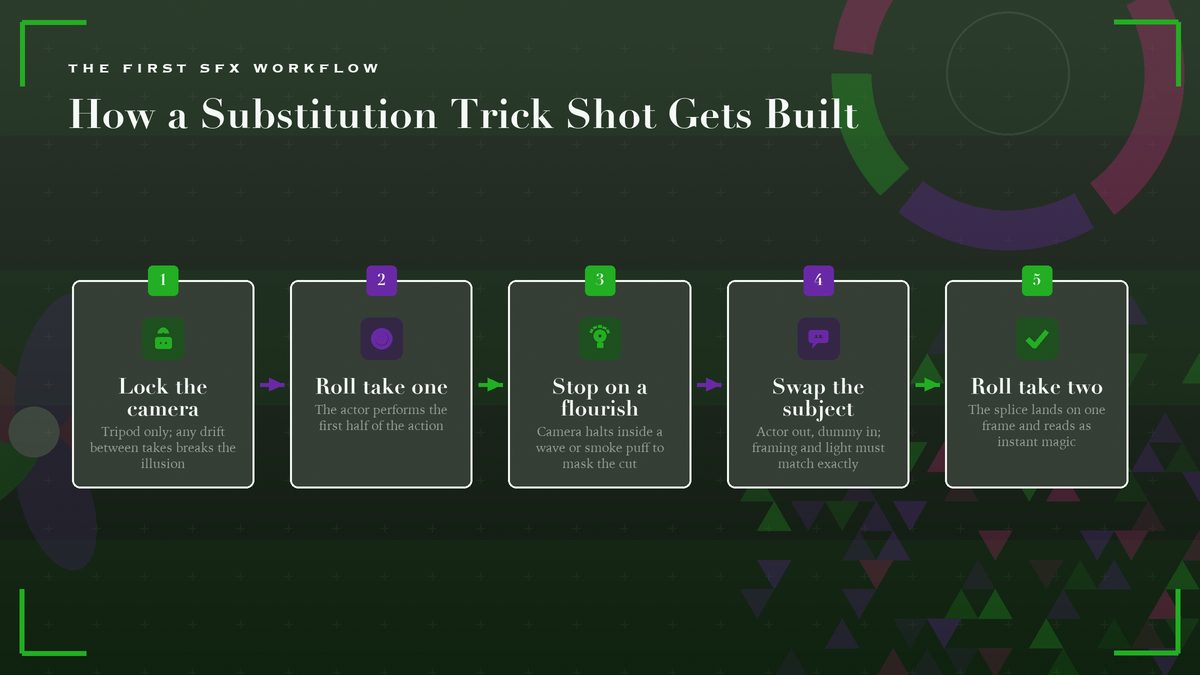
The trick has one famous weakness, and every silent filmmaker knew it. A frame or two of the empty set, or a flicker of light between takes, breaks the illusion completely. Méliès’s solution was theatrical. He’d throw smoke, wave a cloth, or raise his arms in a flourish right at the moment of the cut, so the splice landed inside the misdirection. Stage magicians call this transference, moving attention to the wrong hand. Film simply gave the gesture a new surface to hide on.
Double Exposure Put Ghosts on Payroll
Stop tricks handle transformations, but they can’t make a figure translucent or let it glide through a wall, and silent filmmakers wanted exactly that. For those shots they reached for double exposure, which just means running the same strip of film through the camera twice and recording a second image on top of the first. The dark parts of the second exposure stay transparent, so a figure photographed against a black backdrop appears as a pale, see-through presence floating over the original scene.
It’s the direct ancestor of the green-screen composite, separated from it by about seventy years and a mountain of photochemistry. You can read up on how the technique later became a standard part of cinematography in this overview of double exposure photography. In the silent era it spawned an entire genre of “spirit” films about séances, haunted houses, and souls departing bodies. The 1901 British short Scrooge, or, Marley’s Ghost was among the earliest to put Dickens’s Christmas ghosts on screen this way. Some of these films played straight as moral tales, while others were comedies where the audience was in on the joke from the first frame. It was cheap, too, since you’re just running the same film through twice.
Méliès had a companion technique he called black art, and honestly it’s the cleverer of the two. Forget double exposure entirely. He dressed performers head to toe in black velvet and stood them against a black backdrop, and whatever those hidden figures held seemed to float and move under its own power, because black-on-black simply didn’t register on orthochromatic film stock. That stock was blind to subtle tones, so the whole dark zone collapsed into one featureless void on the negative. Skulls danced, chairs walked, a banjo played itself. No lab work at all, just fabric and film chemistry doing the compositing inside the camera.
Silent filmmakers couldn’t composite in a computer, so they composited in the emulsion, in the fabric, in the paint, in the chemistry. The images had to be engineered before the shutter ever opened.
Speed, Scale, and Running the Film Backwards
Hand-cranked cameras introduced a whole family of accidental effects that directors learned to control on purpose, because the crank speed was a creative dial long before anyone called it one. Crank faster than the projector runs and motion on screen slows down, which is how the silent era got its dreamy slow-motion waves and falling bodies. Crank slower and everything accelerates into the manic, Chaplin-chasing-a-tram speed we now stereotype as “old movie,” even though audiences of the day, watching well-cranked footage, saw motion far smoother than that caricature suggests.
Rewinding was the other free superpower.
Run the exposed film backwards through the camera, expose a second scene onto it, and a diver can leap feet-first out of a lake and land dry on a board. Projectionists also learned to thread a finished print backwards, which turned a building collapse into a building rising intact from its own rubble. The 1903 British film The ‘?’ Motorist ends with a car driving up a building and into the sky, a shot assembled almost entirely from reversed footage and stop tricks.
| Trick | How it was done | What the audience saw |
|---|---|---|
| Substitution splice | Stop the camera, swap the subject, roll again | Instant vanish or transformation |
| Double exposure | Second pass of the film with a dark-background figure | Ghosts, spirits, transparent doubles |
| Black art | Velvet-clad stagehands against a black void | Objects floating and moving by themselves |
| Variable cranking | Crank the camera faster or slower than projection speed | Slow motion or frantic acceleration |
| Reversed footage | Rewind and re-expose, or project the print backwards | Impossible physics, reverse demolitions |
| Mirror shots | A plate-glass mirror removes half the set from the frame | A full room that is secretly half a room |
Miniatures belonged to the same toolbox and worked for the same reason they still do: small models shot with fast motion and heavy atmosphere read as enormous objects moving at human scale. Silent epics burned whole model cities. The 1916 Italian film Cabiria built ancient Carthage in forced-perspective miniature and marched crowds of extras across it to sell the scale, an approach the epics of the 1920s copied and enlarged until entire backlots were given over to what the crews called bigatures. The formula hasn’t changed. Smoke, water sprayed from above, and slightly overcranked cameras make a six-foot wall of plaster look like a burning district.
Germany Paints With Shadows
By 1920 the tricks had matured into a full design language, and nowhere more than in Germany. The Cabinet of Dr. Caligari took a radical approach to horror. Instead of hiding that the sets were artificial, it flaunted them. Houses leaned at impossible angles, trees were twisted lattices of painted canvas, and shadows were slapped straight onto floors and walls in hard black paint. The production had commissioned crazed-looking designs from three painters, and the studio then rebuilt the look on stage, which is why the whole film feels drawn rather than photographed. Painted light, not real light, meant the shadows didn’t have to obey any actual light source, and the nightmare logic hit audiences like a fever.
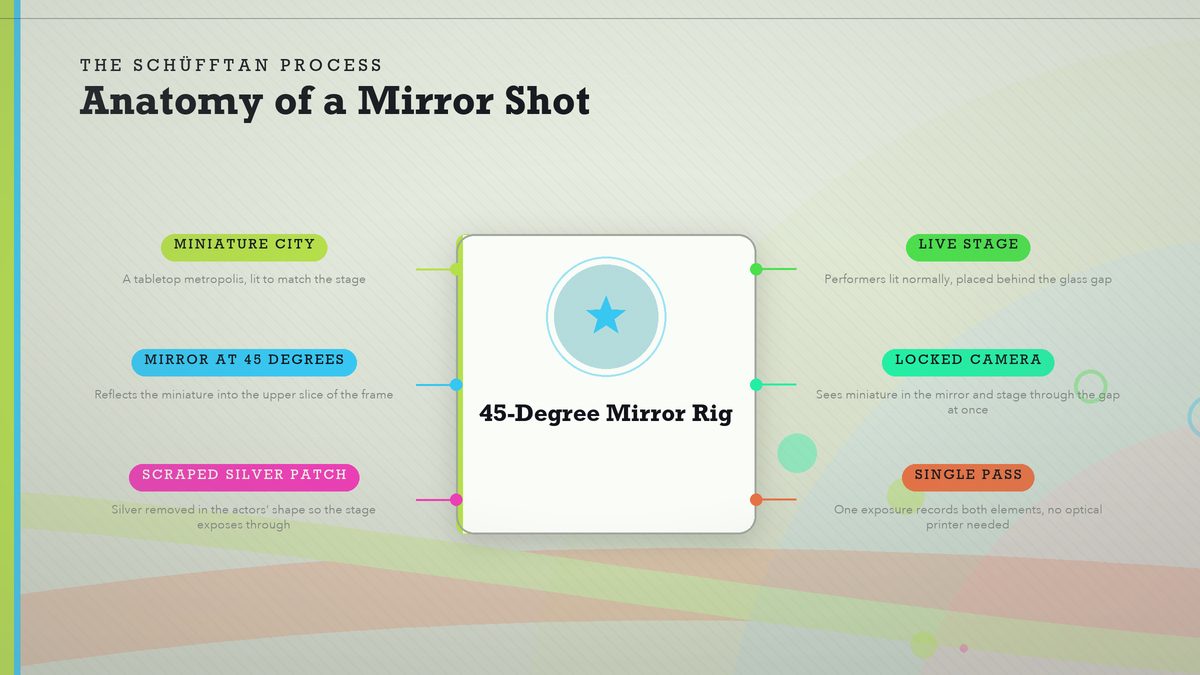
Seven years later, Fritz Lang’s Metropolis went the opposite way, hiding its artifice with ferocious discipline. Its signature device was the Schüfftan process, named for effects man Eugen Schüfftan. A plate of mirror mounted at 45 degrees inside the camera reflected a live miniature of the futuristic city into one section of the frame, while the mirror’s silvering was scraped away in the exact shape of the actors’ area so that the live stage behind it could expose through the gap. One exposure, one camera pass, and a colossal city shared a single real frame with a human face. One pass did it. Variations of the mirror trick then appeared through the 1930s and 1940s whenever a production needed architecture that didn’t exist.
What ties Caligari and Metropolis together is that both treat the trick as part of the storytelling rather than a novelty interrupting it. Caligari’s distorted sets put you inside a madman’s perception; Metropolis’s impossible city makes class division visible as architecture. That’s the lesson the silent era handed to everyone who came after. The best effect is the one that means something inside the story, and the flashiest one that means nothing is just a magic trick wearing a movie’s clothes.
Why It All Survived the Talkies
You might expect sound to have swept these techniques aside, and some did fade. Black art died once more sensitive film stocks could finally see the velvet. But the substitution splice became the invisible cut that editors still use, hiding continuity jumps inside passing motion. Double exposure grew into optical printing and then digital compositing. Variable cranking turned into the high-frame-rate slow motion of every modern action film. And the mirror trick’s direct descendant is the beam splitter, which cinematographers still reach for when two elements must genuinely share one exposure.
More than the hardware survived. The silent era established a working method that visual effects still follows today, one I think about whenever I watch a modern blockbuster. Conceive the impossible image first, find the cheapest in-camera method that produces it, and hide every join where attention might wander. Pre-digital effects supervisors repeated that loop for sixty years. Digital artists repeat it now, just with different tools and bigger render bills.
You Can Shoot Every One of These Tricks This Weekend
The DIY versions need almost nothing. Double exposure is a built-in mode on many mirrorless cameras and some phones; for a classic ghost effect, shoot your “spirit” against a dark wall, keep the camera locked, then swap in your live actor and record the scene a second time over the same frame. Undercranking is now a timelapse mode. Reversed footage is a checkbox in any editing app worth its salt. Even the mirror trick has a home version if you angle a phone against a dark window at night and let the glass do the splitting. I’ve tried the phone version of the stop trick at a family gathering, it took about fifteen minutes start to finish, give or take, and the reaction it got would have felt completely at home in a 1902 cinema.
What you can’t easily replicate at home is the part that made the silent-era masters worth studying, and that’s the misdirection. Méliès trained as a magician for years before he touched a camera, and his film tricks land because he choreographs the audience’s attention to the exact frame where the splice hides. Watch A Trip to the Moon with that in mind and you’ll start noticing the smoke puffs, the arm flourishes, the dancing Selenites, all positioned with stagecraft precision around each cut. The machinery’s simple. The directing around it is anything but.
Trick-film history is well documented, and these techniques are stable enough to have survived a century of technical change. This guide draws on the standard film-historical record, so if any detail here conflicts with newer archival research, the archives win. Related reads on this site include how rear projection and matte painting extended the same ideas, and how Ray Harryhausen carried in-camera craftsmanship into the 1980s.