For half a century, Hollywood faked skylines, deserts, even car chases with a movie projector and a paintbrush. Rear projection and matte paintings put actors anywhere on earth, and audiences almost never caught on.
Watch a 1940s noir and you’ll see two detectives driving through city streets, rain on the windshield, storefronts sliding past the rear window. Except the storefronts were filmed weeks earlier by a second unit, the rain was added later, and the actors were sitting in a prop car bolted to the studio floor. The whole street existed only as light thrown onto a screen behind them. That trick, rear projection (the rear projection effect has a thorough write-up on Wikipedia), carried thousands of scenes, and most viewers never suspected a thing. I find that delightful. Two whole technologies, projection backgrounds and painted glass, were the backbone of location work for decades, and they worked because nobody talked about them.
These weren’t cheap shortcuts, either. A good process shot took real planning, a specialty crew, and equipment that filled a soundstage. Matte painters were often among the best-paid artists on a studio lot. Both crafts sat in that strange category of effects whose success depends on total invisibility, and both got flattened by digital tools in the early 1990s. The problems they solved haven’t gone anywhere, though. Getting a convincing background behind an actor without leaving the lot is still the game, and modern virtual production on LED walls is, if we’re honest, rear projection with better brightness.
How Rear Projection Actually Works
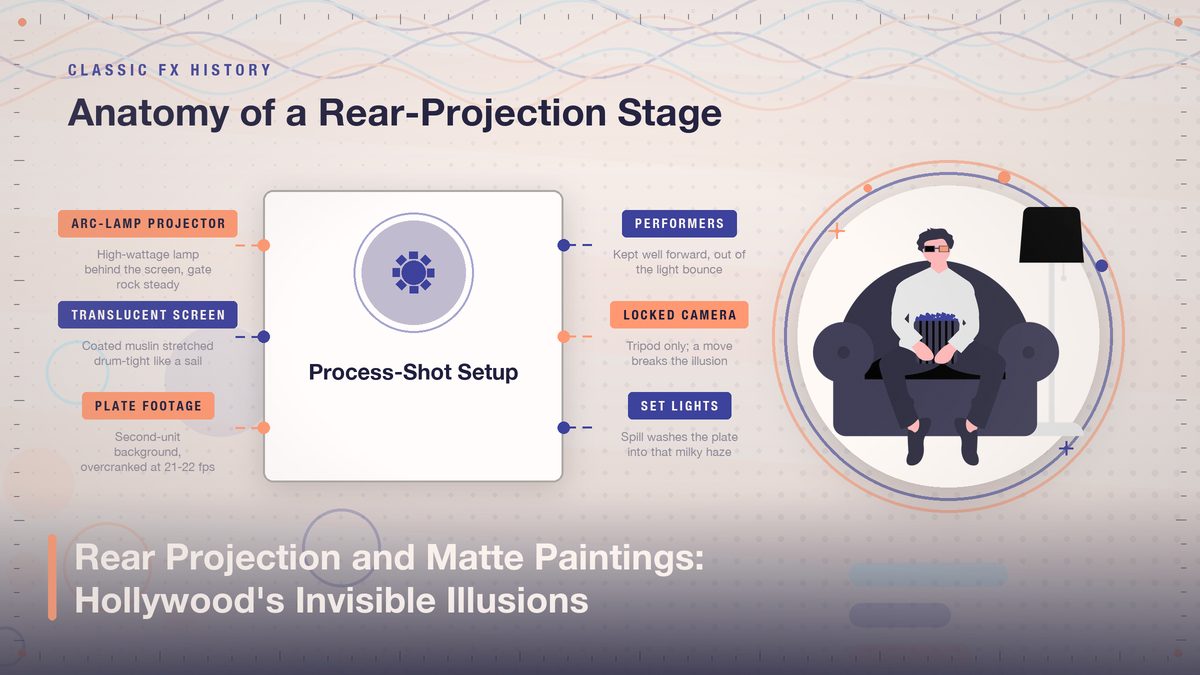
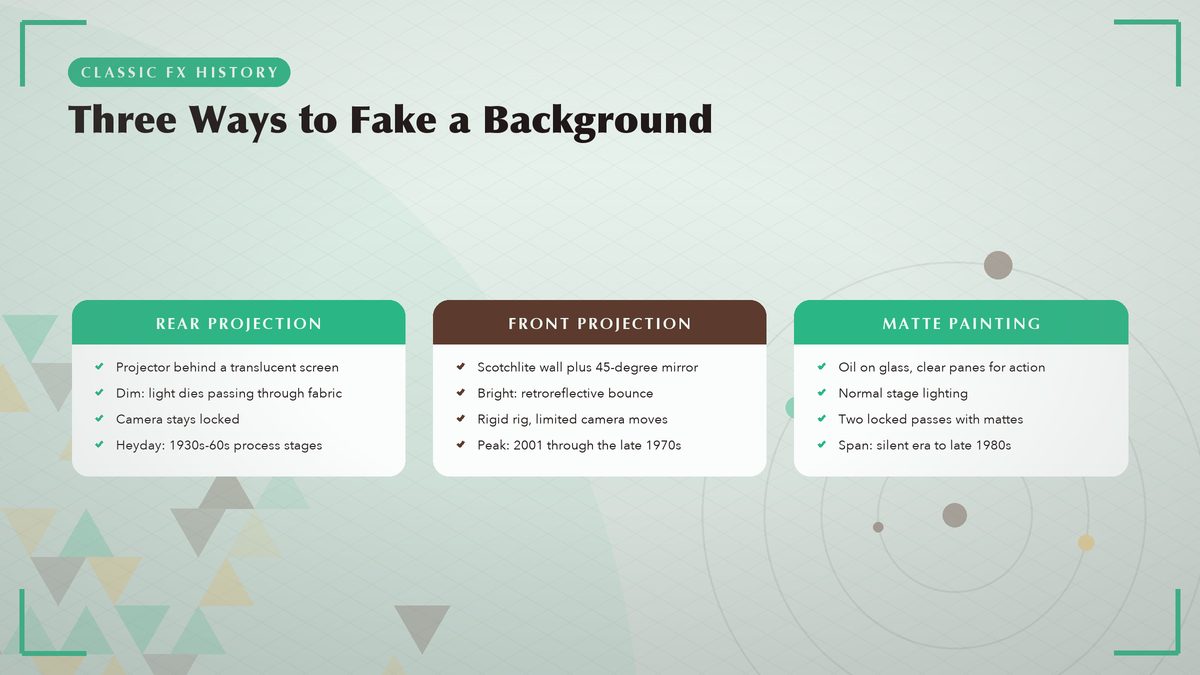
The setup is disarmingly simple. A projector sits behind a large translucent screen, muslin or a coated fabric stretched taut like a sail. The film it runs is called the plate, which is background footage shot on location. Actors perform in front of the screen, the camera photographs both at once, and if everything is aligned and bright enough, the plate reads as the world outside the window.
Simple to describe. Brutal to execute well.
Screens have to pass light while staying smooth, so the fabric can’t be too thick or too thin. The projector needs a serious lamp, because the plate image loses brightness passing through the screen, and film stocks from the 1930s through the 1950s were hungry for light. Fox built its process department around brighter lamps and steadier gates, since any weave in the plate footage turned background buildings into jelly. Then there’s the keystone problem. Aim a projector at a screen that isn’t dead square and the image skews, which means the geometry of the stage matters as much as the acting does.

The Plate Is Where the Magic Lives or Dies
Second units shooting background plates worked under rules that sound odd until you picture the projector running them back on the stage. They overcranked the camera, running at 21 or 22 frames per second instead of 24. Projected and re-photographed, the plate picks up speed and looks normal again. They kept the camera lower than an eye line you’d notice, since a plate shot from six feet up makes actors look like they’re standing in a hole. And they protected the center of the frame, because that’s where the performers would be composited in.
Get any of that wrong and there’s no fixing it. The stage day is booked, the cast is standing by, the background is what it is. It happens. Plate shooting must have been a strange gig, when you think about it, you were filming footage whose entire job was to be ignored.
Why Rear Projection Looked So Grainy
If you’ve sat through a lot of old process shots, you know the tell. The background swims with grain, the contrast looks flattened, and there’s a faint milky haze over everything, like the scene was remembered rather than witnessed. That haze is light bouncing off the actors and the set, scattering back onto the screen and washing the plate out. Bigger stars meant bigger problems, because a white shirt or a blonde close to the screen threw enough light back to visibly fog the background.
Every seat-filler in a 1940s process shot is standing inches from a glowing wall, trying not to cast a shadow on the world.
Color made everything worse. Three-strip Technicolor chewed through projection light, so early color process shots looked dim and muddy next to their black-and-white siblings. Studios responded with tighter staging, actors kept forward and deep sets avoided, and audiences simply accepted the look as part of “movie-ness.” Fair enough, really. A modern viewer spots the grain in a heartbeat, but a 1948 audience had no frame of reference for anything smoother.
Front Projection: 2001 and the Scotchlite Fix
The best answer to rear projection’s light loss showed up in 1968, and it came from a material made for road signs. Scotchlite, the retroreflective bead coating developed by 3M, bounces light almost straight back at its source instead of scattering it. Cover a stage wall in the stuff, put a one-way mirror at 45 degrees in front of the camera lens, and you can throw a projected image through the mirror onto the wall, where it bounces straight back through the mirror into the camera.
Actors stand between the mirror and the wall under normal lighting. Nobody performs in the dark. The projection survives because almost none of its light gets wasted. Stanley Kubrick used the rig on 2001: A Space Odyssey to put astronauts on the African savanna and the moon’s Clavius base, and the results still hold up better than most blue-screen work from the same decade. The 45-degree mirror is the same arrangement a teleprompter uses, which always tickles me. The most inscrutable film of the 1960s borrowed from cue-card technology. No kidding.
Front projection killed the grain and the haze in one move, but it had limits of its own. The retroreflective screen carried a subtle texture that could shimmer under certain lights, sets had to be dressed so nothing else in frame caught the projected image, and the technique never loved moving cameras. No washout, though. No jitter either. It ruled the 1970s, Superman and The Empire Strikes Back among its credits, then gave way to blue and green screens as compositing quality improved.
Matte Paintings: Sets You Can Hold Up With One Hand
Projection replaced the background with light. Matte painting replaced it with a painting, usually oil on glass, with the live action photographed through the clear areas of the pane.
The classic method used a matte, a black silhouette on a second strip of film that held back the painted area during live-action photography, then a counter-matte that held back the live action while the painting was photographed onto the same frame. Run both passes and the two images stack into one frame. Two passes, one image. The painter’s job was to match the set’s lighting and its perspective closely enough that the seam sat in shadow or haze, invisible at 24 frames a second. You can trace the craft from silent-era matte painting through its long studio heyday in the Wikipedia overview.
And the painters were something else. Peter Ellenshaw spent decades at Disney extending real sets into storybook distances. Mary Poppins‘s London rooftops, whole harbors in Treasure Island. His canvases were often thirty feet wide, painted in grays and then colored to match the film stock’s quirks. Emil Kosa Jr. gave Fox its cathedral interiors and flooded streets. Albert Whitlock, Hitchcock’s go-to, stretched a low-budget The Birds into a coastal town under siege, and later took home an Academy Award for his earthquake work, plus an honorary Oscar for the craft itself in 1985. The Academy’s official site keeps the honorary award list, which is a good reminder that Hollywood understood these people were wizards.
What gets me is how physical it all was. No undo button, either. A matte painter needed architecture and perspective, color timing, a feel for what a lens does to distance. One wrong vanishing point and the illusion folds. Some paintings hid their seams in a window frame; the boldest ones ran the seam straight through moving water or crowds, where the eye is too busy to measure anything, more or less the same judgment calls a compositor makes in software today, just made with a mahlstick.
The Glass Era Ends Quietly
By the late 1980s, digital compositing could blend a scan of a painting with live footage without the matte edges showing, and within a decade the paintings themselves went digital, first scanned, then painted in software from scratch. The last big hand-painted glass mattes overlap with the first digital ones. Nobody threw a retirement party for the pane of glass. Today’s matte painters, working in Photoshop and Nuke, are direct descendants of Ellenshaw’s generation. The tools changed. The eye didn’t.
The Psychology of a Clean Cheat
There’s a reason these tricks survived fifty years despite visible flaws. Your eye is a lazy auditor. It checks the actor’s face, the dialogue, the thing that moves, and it lets the background pass as long as the background behaves. Motion sells a scene harder than resolution does, which is why a slightly grainy plate with buses rolling past felt more real than a sharp, still backdrop ever could. Hitchcock understood this better than anyone. Keep the story gripping and the audience will forgive a background that swims, because they’re too busy wondering what’s behind the door.
Film grammar plays a part too. Decades of movies taught audiences to read certain images as “real” even when the physics were off. A car rear window with scenery sliding by meant travel, full stop. A painted skyline behind a balcony meant the rich part of town. Once a shorthand gets established, it takes shockingly little to maintain, and every effects artist since has counted on that. I’ve watched seasoned viewers sit through a 1950s process scene and only notice the projection when someone points at it. Point taken, literally.
What This Has to Do With Your Green Screen
Every background method in film history has been a trade. Brightness, camera freedom, how much the crew can fix afterward: a production gets to keep two, maybe, and pays for the third. Rear projection traded camera freedom for a finished image on the day. Matte painting traded mobility for artistry. Green screen traded everything for post-production labor, which is roughly why it won.
| Method | Brightness for the actor | Camera movement | Fix-it-in-post? |
|---|---|---|---|
| Rear projection | Dim; fights the set lights | Modest; no big moves | Almost never — the shot is baked |
| Front projection | Excellent | Limited; rigid rig | Rarely |
| Matte painting | Normal stage lighting | Static passes, locked camera | Seam repairs only |
| Green / blue screen | Normal, but spill on edges | Free | Yes — that’s the whole point |
| LED volume | Real, from the wall itself | Free within the wall | Some, but less than you’d think |
Which brings us full circle. A modern LED volume stage, the setup The Mandalorian made famous and documented under the name virtual production, is a wall throwing moving scenery behind actors while the camera rolls both together. Swap the wall’s LEDs for a projector and a screen and you have a 1937 process stage with better contrast. The industry spent sixty years replacing rear projection, then rebuilt it in higher resolution because the original idea was right all along: light the actor with the background and the eye believes everything. I think that’s kind of wonderful, honestly.
Nobody watching Mary Poppins fly over London knew they were looking at thirty feet of oil paint. That was the job.
Try It Yourself: A Backyard Process Shot
You can feel the rear-projection problem in an afternoon. All you need is a cheap video projector, a translucent white shower curtain or a roll of diffusion fabric, a camera on a tripod, and a phone clip of a street or hillside to serve as your plate.
- Stretch the screen tight. Any wrinkle in the fabric shows up as a wobble in the background, so pull it drum-tight and anchor it with painter’s tape in a doorway.
- Project your plate from behind. Kill the room lights, step in front of the screen, and notice how dim you look next to the plate. The projector’s fan will want to live on your soundtrack.
- Keep yourself off the screen. Stand as far forward as the framing allows. Your body will still throw light back and wash the image out, which is why 1940s process shots carry that haze.
- Lock the camera. Handheld over a projected background is what sells the fake. A $20 phone tripod earns its keep here.
- Grade the plate down. Drop its contrast. Drop its saturation a touch, too. The plate should look slightly flatter than you do; that’s the error your eye expects from a window.
Run the test, then watch your footage next to any old studio picture. The grain, the haze, the slightly off contrast, you’ve now reproduced with about forty dollars of hardware what gave a 1940s process department daily headaches. And the projector will be the loudest thing on set, which no era has fixed.
For a painted-background variation, skip the projector. Photograph yourself in front of a plain wall, print a skyline photo, shoot it through a window cut in black card, and composite the two in any editor with a luma matte. It’s the poor man’s matte, and it teaches the one lesson every matte painter lived by: hide the seam where the light is softest.
And maybe that’s the right place to leave it. The next time a film plants its characters in front of an impossible view, you’ll catch yourself asking the old questions: how much of this is light, how much is paint, and how much is the audience doing the work for free.
Want more behind-the-scenes FX history? Read our breakdown of stop-motion’s golden age and our look at miniature sets and forced perspective. External references: the Wikipedia entries on rear projection and matte painting, plus the Academy of Motion Picture Arts and Sciences site.