Seven skeletons climb out of the earth, draw swords, and attack a living man, and nobody in the theater doubts a frame of it. That fight in Jason and the Argonauts ran about four minutes, took one animator something like four months, and it remains the scene every effects artist points to when asked what handmade movie magic looks like.
Ray Harryhausen spent most of his career working alone in a garage workshop, moving puppets a fraction of an inch at a time, and he still ended up inventing half the visual language of modern fantasy film. Watch a bronze statue wake up on a beach or a skeleton pull itself together on a battlefield and you’re watching his ideas at work. George Lucas, Steven Spielberg, Peter Jackson, and Tim Burton have all said versions of the same thing in interviews over the decades: their imaginations got built in front of Harryhausen pictures. His original models and drawings survive in the Ray Harryhausen Foundation, that’s a big part of why we can describe his methods with this much confidence.
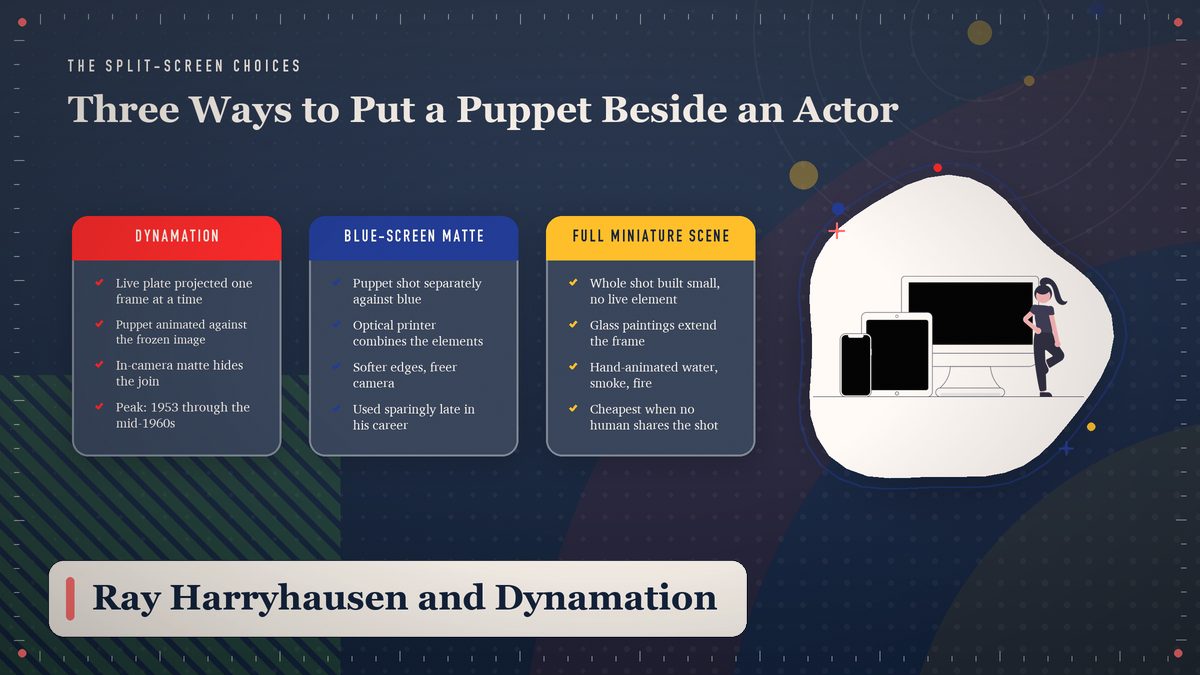
Dynamation was his own name for the split-screen process that put those stop-motion creatures into the same frame as live actors. He trademarked the word. Nobody else used it. The label was half showmanship. Underneath sat a genuinely clever piece of photographic problem-solving that he kept refining from a cheap 1953 monster picture all the way to Clash of the Titans in 1981.
A Teenager Walks Out of King Kong Changed
Harryhausen was thirteen when King Kong opened in 1933, and by his own oft-repeated count he went back around thirty-three times in that first year. He wasn’t a casual repeat viewer. He was a kid with a home movie camera trying to work out how the big ape moved, and he badgered his way into a meeting with the man responsible, animator Willis O’Brien, who responded by showing the boy how an armature goes together and letting him hang around the RKO lot. That kind of access didn’t happen then, and it’s even rarer now.
The apprenticeship produced real work. After a short stint in George Pal’s Puppetoons shop and wartime service making training films for the Army Signal Corps, Harryhausen landed on Mighty Joe Young in 1949, where O’Brien supervised and a large share of the actual gorilla animation fell to the younger man. The picture’s effects team won an Academy Award. O’Brien took the statue home; Harryhausen got the education. I’ve always thought of that film as his graduate degree.
Every Harryhausen picture for the next thirty years is basically one man in a dark room, nudging a puppet, clicking the shutter, and doing it again.
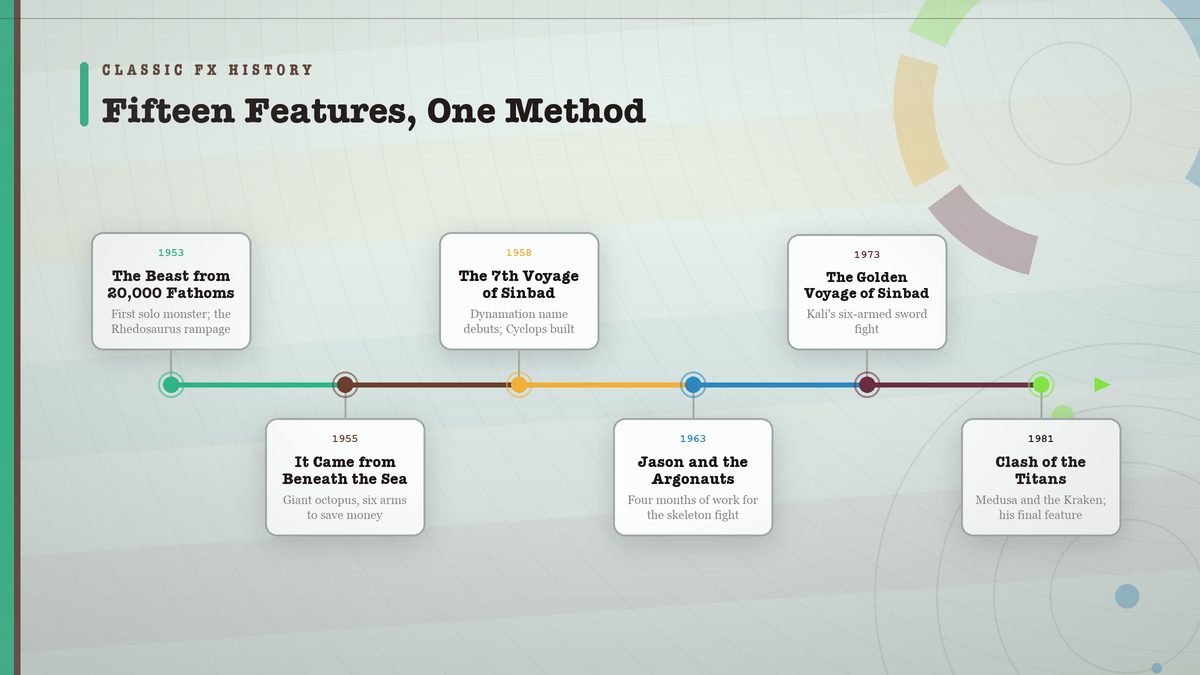
His first solo feature arrived in 1953: The Beast from 20,000 Fathoms, shot for roughly two hundred thousand dollars, which even in that decade was pocket change for a studio picture. The Rhedosaurus wrecked a lighthouse, swallowed a policeman, and put a twenty-eight-year-old animator’s name in front of producers. The overview of his career shows how that one cheap monster movie turned into a fifteen-film run.
What Dynamation Actually Does
The part that sounds impossible until you see the mechanics
Animators had combined puppets with live footage before Harryhausen, usually by rear projection, which meant background footage thrown onto a screen while performers acted in front of it. The result always looked wrong for the same reasons: the projected image came out milky and unstable next to crisp photography, and the two elements shared a frame the way strangers share an elevator. Harryhausen reversed the order. He photographed the actors first, then rear-projected their footage one frame at a time behind his miniature set, and animated his creature against that frozen image. The camera did the combining, not an optical printer, and a split matte kept the two halves of the frame apart until both had been exposed.
But the name itself was a producer’s brainstorm, cooked up for The 7th Voyage of Sinbad in 1958, his first picture in color, because Columbia wanted audiences to know they were paying for something new. The technical writeup of Dynamation lays out the same process; what matters is that it’s in-camera split-screen compositing done a single frame at a time.
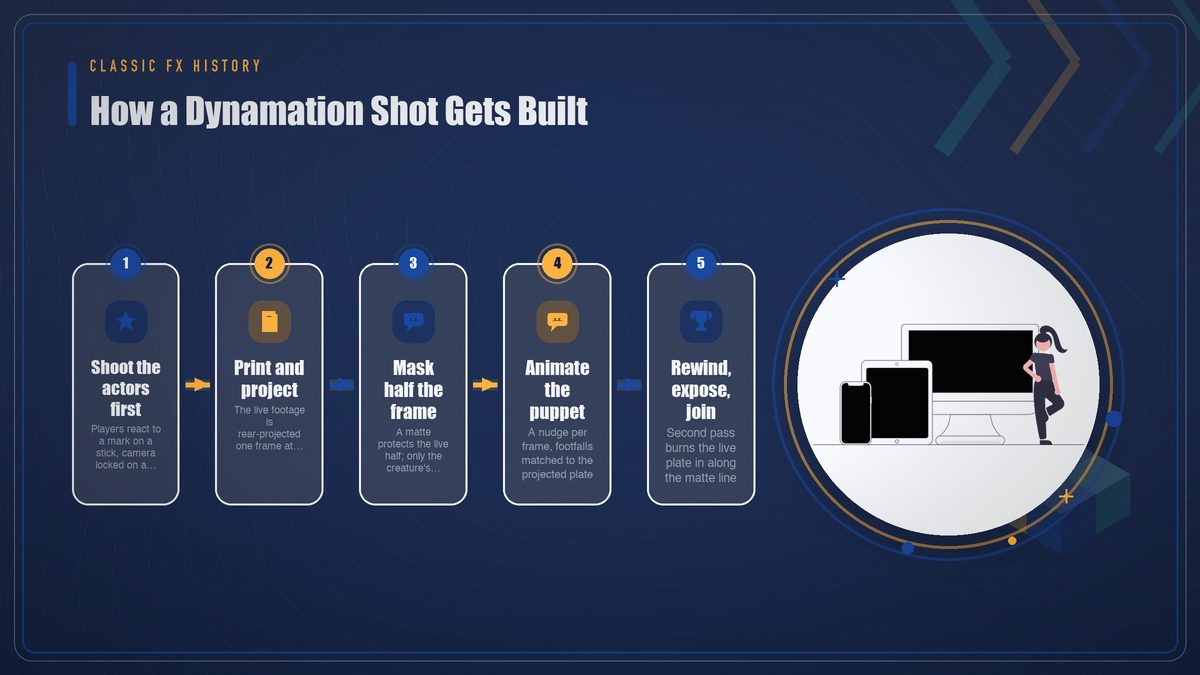
A shot would pass through five stages, and the whole thing reads more like a watchmaker’s routine than anything you’d call a film set:
- Shoot the actors first. The performers play against nothing, usually an eyeline mark on a stick or a rough plywood stand-in. The camera stays locked hard on a tripod.
- Print and project. The footage goes to the lab, comes back as prints, and gets rear-projected behind the miniature set on demand, one frame whenever the animator asks for it.
- Mask the frame. Half the camera gate is blocked with a matte so the film only sees the patch of ground where the creature will stand. The live-action half stays unexposed.
- Animate. Harryhausen nudges the puppet, trips one frame, checks the projected background for foot placement, and repeats the cycle a few hundred times for a shot that lasts seconds.
- Rewind and expose the other half. The film runs back to frame one and the matte flips to cover the puppet area. Then the live-action plate burns into the untouched half along the same matte line. A slight overlap hides whatever seam is left.
Both halves pass through the same lens in two passes on the same strip of film. So they inherit identical grain and focus. An optical printer combining separately shot elements almost always leaves a join you can catch on a rewatch, but an in-camera split hides itself completely, which is why his creatures still look planted in the frame beside a human being.
Why Shoot the Actors Before the Creature?
Order matters more than you’d guess. Animate the creature first and the actors must later react to tiny preview frames, marks hit in a scene with all the energy drained out of it. Harryhausen wanted the opposite: real performances with real timing, recorded first, so his job became making a puppet honor what the actors had already given him, the creature as supporting player doing take after take until it matched the star.
Building a Creature That Could Carry a Close-Up
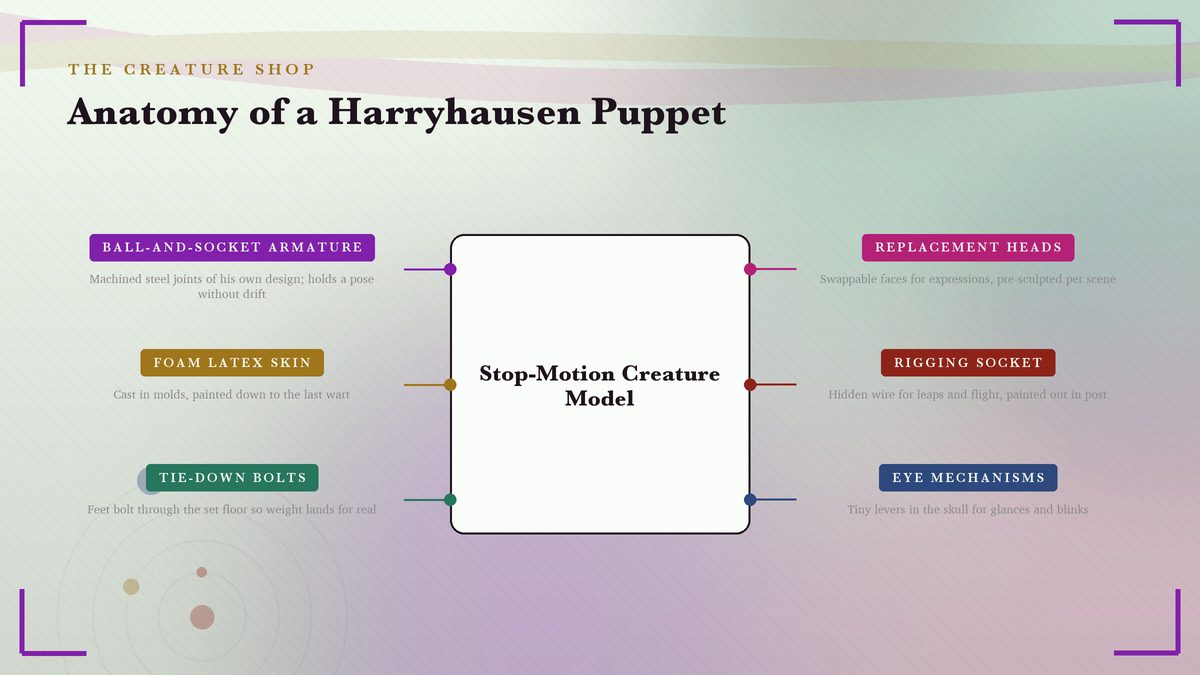
None of the compositing would count for anything if the puppets didn’t survive scrutiny. Harryhausen built his models around steel armatures with ball-and-socket joints he machined to his own design, because the joints you could buy either wore loose after a week or refused to hold a pose under a day’s handling. Foam latex skin went over that frame, cast in molds and painted down to the last wart, with little mechanisms inside the skull for eye movement.
And scale ran around a foot tall for human-sized creatures, more for giants like Talos, the bronze sentinel in Jason and the Argonauts. Stop motion can’t fake contact with a floor, so the feet bolted through the set on hidden tie-downs, and when a skeleton planted its feet and lunged, you felt the weight travel up the body. Audiences read weight as real faster than they read texture or articulation. Faster than almost anything else.
He made his own supporting effects too. Miniature sets shared the workshop with bubbling mud pots and painted glass skies, and whenever a scene had no human in it he’d skip the split-screen work and simply shoot the whole thing small, with hand-animated water and smoke added frame by frame. My favorite detail is how little of this he delegated, because the sculpting, molding, painting, rigging, lighting, and animation all ran through one pair of hands, often the design work too.
Jason and the Argonauts, the Fight Everything Else Gets Measured Against
If you know one Harryhausen sequence, it’s the skeleton fight from Jason and the Argonauts in 1963. Seven skeletons claw out of the soil, pick up swords and shields they have no business holding, and battle Jason and two companions across a cliffside. On screen it runs about four minutes. In Harryhausen’s workshop it ate something close to four months.
He said a productive day on that fight meant about thirteen finished frames. Thirteen frames is barely half a second of screen time, so do the arithmetic and you’ll see why the sequence became legend among animators before it became legend among audiences. Watch the fight frame by frame and you can still spot the joins, a matte line here and a doubled shadow there, but the eye forgives all of it because the weight never lies. The film’s production history covers the shoot, and the line back to Willis O’Brien shows whose methods Harryhausen was perfecting the whole time.
Half a second of film per good day. Four months for one fight. And audiences in 1963 didn’t know any of that, they only knew the skeletons were real.
The rest of Jason is nearly as crowded with ideas. Talos the bronze giant turns his head with a shriek of metal that fantasy films have been quoting ever since. Triton heaves out of the sea to hold the Clashing Rocks apart for the Argonauts’ ship. Harpies torment a blind man on a lonely island, and a field of jewels springs up where Hydra’s teeth hit the ground. Through all of it, producer Charles H. Schneer kept the pictures modest in budget and generous in creature content, a partnership that ran from It Came from Beneath the Sea in 1955 all the way to the end.
Between the Sinbad pictures, the pattern held. Mysterious Island gave 1961 audiences a crab the size of a barn and a stretchy giant bee, and First Men in the Moon landed his creatures in H.G. Wells territory. It Came from Beneath the Sea had set the tone back in 1955, when its giant octopus went out into the world with six arms instead of eight, because two arms’ worth of animation was money the production didn’t have. Cheaper, and nobody noticed. When The Golden Voyage of Sinbad arrived in 1973, Kali’s six-armed sword fight proved he could still stage choreography that no live stunt team would survive.
| Creature | Film | Why it’s remembered |
|---|---|---|
| Rhedosaurus | The Beast from 20,000 Fathoms (1953) | His first solo monster; the lighthouse destruction is still studied |
| Cyclops | The 7th Voyage of Sinbad (1958) | Goat-hooved and hungry; one of the great one-eyed designs |
| Ymir | 20 Million Miles to Earth (1957) | Grows from lizard-sized to siege engine; a sympathetic monster |
| Skeletons | Jason and the Argonauts (1963) | The four-minute fight that ate four months |
| Kali | The Golden Voyage of Sinbad (1973) | A six-armed statue that sword-fights three men at once |
| Medusa & the Kraken | Clash of the Titans (1981) | His final feature; Medusa’s rattlesnake tail still unsettles |
The Long Goodbye
By the late 1970s, stop motion had a young rival called computer graphics, and Harryhausen could read the writing as well as anyone. Sinbad and the Eye of the Tiger underperformed in 1977 despite a charming saber-toothed tiger and a walrus the size of a truck, and Clash of the Titans in 1981 became his last feature, a picture that even put Laurence Olivier on a cardboard Olympus bellowing as Zeus, which tells you how much gravity the old creature features could pull by then. He was about sixty-one. After three decades of frame-by-frame labor, he walked away from features for good, Bubo the mechanical owl and all.
Retirement didn’t dim him. The Academy handed him the Gordon E. Sawyer Award in 1992 for a career’s contribution to the craft, Pixar slipped a restaurant called Harryhausen’s into Monsters, Inc., and veteran effects supervisors kept name-checking him in commentary tracks. The Medusa sequence in Clash of the Titans, lit in near-darkness with a flickering torch effect, still unsettles people who know exactly how the puppet works. He tinkered with short personal projects in his London workshop for years afterward, mostly for his own amusement, and died there in May 2013 at ninety-two. To be fair, few animators in any medium get to watch their technique grow into an entire genre.
What a Hobbyist Can Steal From Him
You won’t rebuild Dynamation in a garage, mostly because nobody makes single-frame rear projectors anymore, but the thinking underneath it moves straight to a phone and a laptop. Lock the camera. Shoot your actors before you animate anything. Give the creature weight by anchoring it to something real in the plate. Then composite with the same two-pass discipline in After Effects or DaVinci Fusion: lay the puppet element over the untouched half of the frame and mind the matte line the way he’d have wanted. I keep coming back to the tie-downs as the single most stealable idea.
One more habit worth copying is the frame rate. He animated mostly on twos, twelve poses a second, because twenty-four unique poses for each second of film would have doubled his schedule for a gain no eye demands. Your phone project can steal that too.
The other lesson is patience treated as engineering rather than virtue. His output across the peak decades averaged one picture every couple of years, each carrying maybe a dozen major effects sequences, and he never once sped up the daily rate. I called his method stubborn earlier, which undersells it a little; stubbornness implies refusing to change, and he changed constantly. The matte line and the armatures got polished from picture to picture while every other part of his working life stayed almost comically the same. If your weekend project feels slow, run the skeleton-fight math again: half a second of finished film per good day, sustained for months, produced one of the most celebrated action scenes ever photographed.
His films endure not because the effects were perfect, they weren’t, but because one identifiable person’s taste sits inside every frame. Modern pipelines split that authorship across hundreds of artists, and most of the time that’s the right trade. Sometimes it costs a picture something you feel without being able to name.
Somewhere right now a kid with a phone and a hallway’s worth of patience is shooting their first skeleton fight. Harryhausen would probably check that the camera was locked, then tell them to keep going.
Creature design drawings, original armatures, and Harryhausen’s own production notes are preserved by the Ray Harryhausen Foundation. Further reading: our breakdowns of stop-motion’s golden age and rear projection and matte paintings, the techniques Dynamation grew out of.