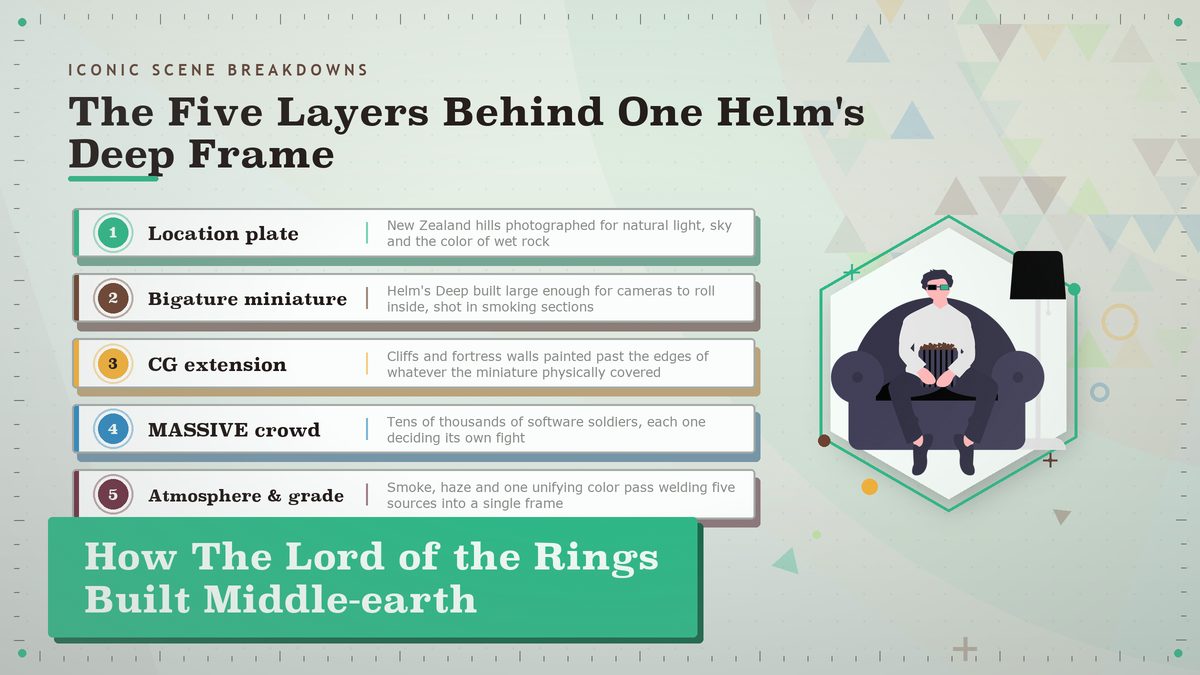
Two decades after it premiered, the siege of Helm’s Deep still looks better than most battles made with far newer tools. Peter Jackson’s team got there with stone-and-glue miniatures, a brand-new crowd simulator, and just enough CGI to hold the two together. This is the recipe they used, and why it refuses to age.
Rewatch the battle of Helm’s Deep today and something odd happens. Nothing looks odd. The rain is real water on real stone, the torches throw real light on real faces, and when ten thousand Uruk-hai charge the wall you believe every one of them has somewhere to be. This for a battle that mixes at least four separate techniques, often inside the same frame. The Lord of the Rings trilogy arrived between 2001 and 2003, right at the moment when computer graphics were good enough to attempt anything and honest enough to betray you the second you trusted them completely. Jackson’s answer was to refuse the choice. He built whatever he could photograph, extended what he couldn’t, and only then let the computer fill in the numbers.
That hybrid philosophy is why the films still feel expensive in a way many newer, costlier movies don’t. I’ve sat through the trilogy maybe a dozen times, and the wide shots of Minas Tirith keep reading as documentary footage of a real place, because under the pixels there’s an actual model somebody sanded, painted, and argued over.
Three ingredients did the heavy lifting. There were “bigatures” (miniatures so large the crew figured the word small didn’t apply), digital doubles for moments no actor could survive, and a crowd-simulation program called MASSIVE that handed each soldier its own little brain. Each one covers a weakness of the one before it, so they make the most sense in order.
Nobody Was Going to Build Helm’s Deep Full Size
The first problem was architectural. A fortress like Helm’s Deep, or a tiered city like Minas Tirith, can’t exist at full scale for any budget on this planet. The standard Hollywood answer was a tabletop model you photograph quickly and never linger on. Jackson’s team at Wētā Workshop went the other way and built the biggest miniatures the industry had ever seen, at scales that crept up to about one quarter of full size. Crew members started calling them bigatures, and the term stuck around the business.
Scale buys you physics. Light falls off with distance. Smoke thins out. Water shatters into realistic spray. All of that happens automatically in a big model, the way it never quite does in a render, no matter how many hours you spend tuning it. The Helm’s Deep bigature was a fortress built in sections, with wall pieces that could be pulled apart so a camera could sit inside what was supposed to be solid stone, and each section had damaged twins standing by for the later, uglier story beats. It was photographed like a location shoot over months of production, because that’s more or less what it was.
One detail I love, because it’s pure stagecraft. The mountains looming behind the keep weren’t part of the fortress at all. They were a separate forced-perspective backdrop, built smaller and set closer so perspective did the shrinking for free. If you want the math behind why that works, our breakdown of miniature sets that look full size runs the same trick with shoebox-sized examples.
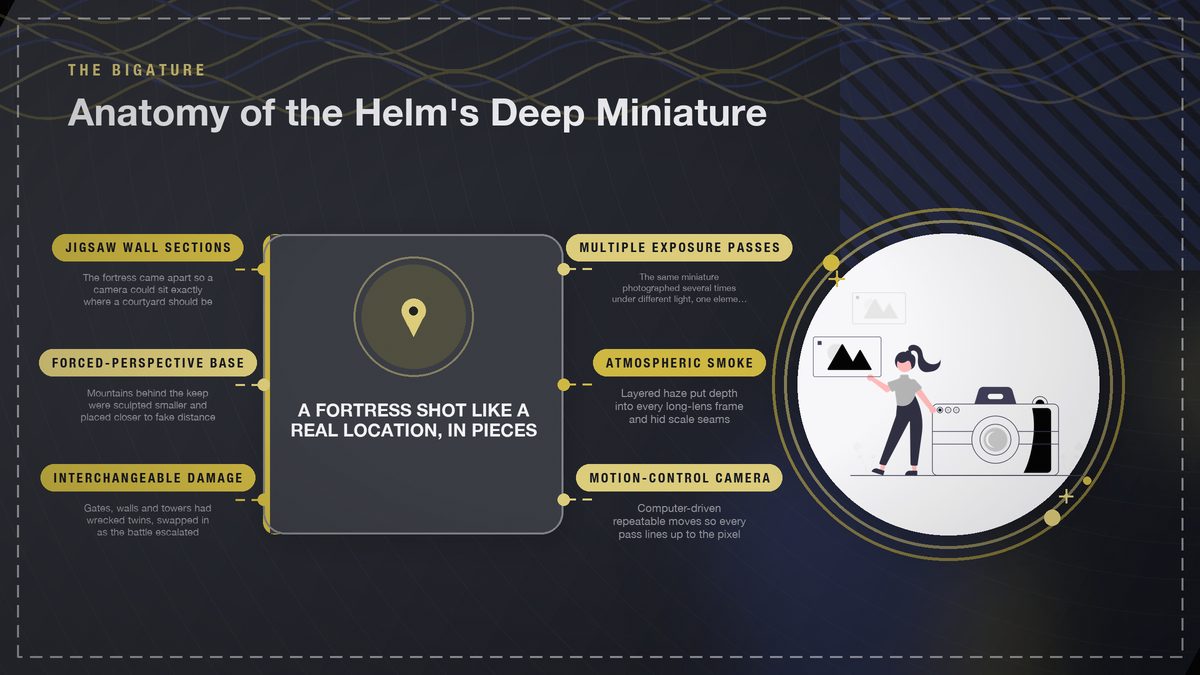
The multiple-pass trick deserves its own paragraph. Instead of lighting the entire miniature in one setup, the crew photographed it several times and changed only the lighting between runs. One pass for torchlight. One for moonlight. One for the explosions. Motion-control rigs made the camera repeat its move down to the pixel, so the compositors could mix those passes like ingredients, rebalancing the lighting of a shot weeks after the model was packed away. A model, in other words, ended up with the kind of post-production flexibility people assume belongs to CGI alone.
A bigature is a location shoot where the location fits in a warehouse, and where the mountain range is closer than it looks.
The Weather Was a Cast Member
Scale alone doesn’t explain the look of Helm’s Deep. The battle happens at night, in driving rain, and that weather is doing effects work of its own. On the full-size sets, rain towers ran for hours at a stretch, soaking costumes and turning the ground to the gray soup you see on screen, and the same wet-down treatment went to the bigatures, where moisture on stone changes how light bounces the same way it does on a real castle wall.
Night shooting helped the same way. Torchlight flatters everything it touches, which meant the crew could light the full-size sets with a handful of flickering sources and let the bigature passes echo that warmth in post, so a frame assembled from five different elements still felt lit by one moon. Continuity of light, more than any single technique, is what glues a hybrid shot together.
Water is merciless to weak effects, which is exactly why the filmmakers wanted it. A crowd of rubbery CG figures might pass on a dry afternoon; put them in rain and every wrong highlight betrays them. Rain gives the compositor free streaks and distortions to hide behind, and it keeps the eye from settling anywhere long enough to inspect it. I think that’s half the reason the sequence still convinces. The weather is covering for everyone.
The Crowd Problem Nobody Could Paint Around
Even the biggest bigature has a hard ceiling, and that ceiling is people. Helm’s Deep calls for something like ten thousand fighters, and the Pelennor Fields battle in the third film goes far past that. New Zealand offered plenty of rugged hillsides and a decent supply of tall extras, but a few hundred real soldiers duplicated by optical tricks stop convincing fast. We wrote a whole history of matte painting on this site, and armies are exactly the kind of thing glass paint could never solve.
So Weta Digital’s Stephen Regelous wrote a program that came to be called MASSIVE, short for Multiple Agent Simulation System in a Virtual Environment. The concept is almost disarmingly simple. You don’t animate a crowd at all. You give each member of it a brain, a body, and a set of senses, and then you let the battle happen.
Each soldier in a MASSIVE crowd is an independent agent. Its brain is a stack of fuzzy-logic rules along the lines of “if an enemy is within arm’s reach, swing your weapon,” and its senses report where nearby friends and enemies stand. Nobody choreographs the charge. The charge is what ten thousand brains decide to do at once when every rule points the same direction. The animators’ job was feeding the system good options, and for that they leaned on real stunt performers, whose motion-captured fights became the library of actions an agent could pick from in the middle of the scrum.
The team then dressed the agents in thousands of body, armor, and face variants so the field never visibly repeated itself. Regelous received a Scientific and Technical Academy Award for the software in 2004, arriving after the trilogy’s run of Best Visual Effects nominations and wins had already made the results famous.
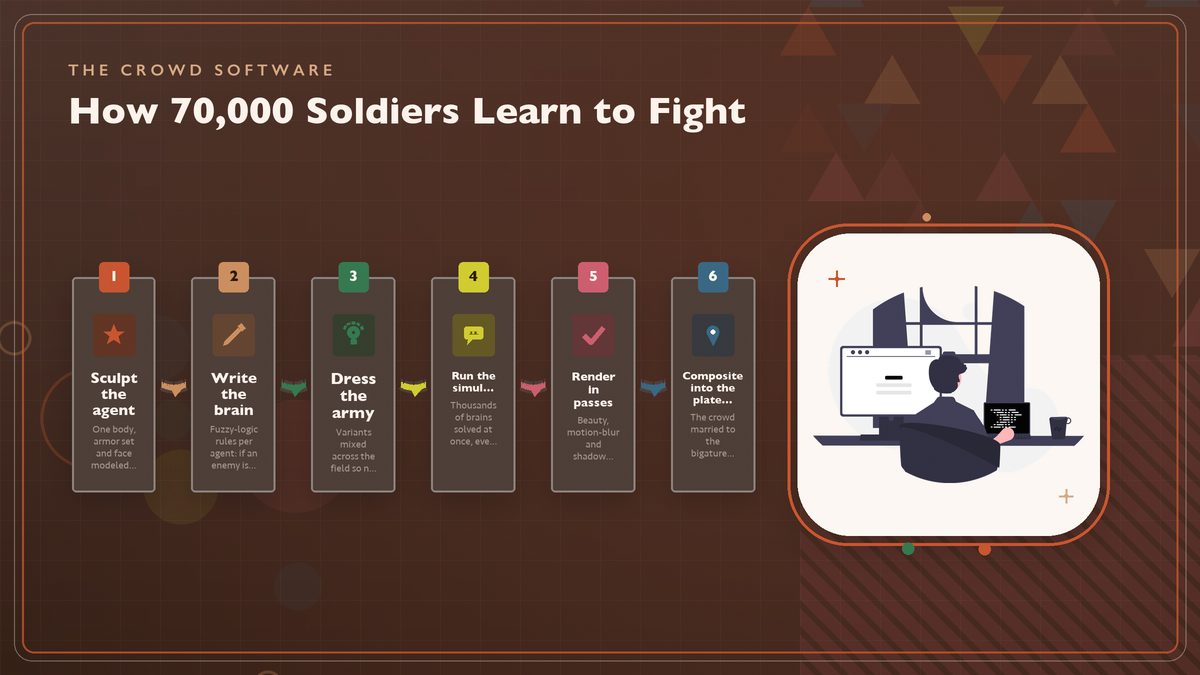
Published figures put the largest Helm’s Deep shots at around 70,000 agents, though counts shift depending on whether you include the ones milling behind the ridge. Honestly, the number matters less than the behavior, and the behavior was new. Before MASSIVE, crowds either looped a handful of animations (you spot the repetition by the second viewing) or were painted in as static texture. These soldiers pick their own targets, stumble, climb over the fallen. Your eye accepts the mass because each small piece of it acts like a person. Roughly, anyway. Close enough for a rainy night.
Digital Doubles: The Stunt People Who Can’t Get Hurt
Between the bigature and the crowd sits the third leg of the stool. When Legolas shield-surfs down a staircase or a rider gets hurled off a collapsing bridge, no stunt performer can quite do that, and no miniature can carry a face the audience knows. So the effects team scanned the principal actors, built fully rigged CG replicas, and used them exactly where stunt physics and actor identity both mattered.
The doubles did double duty. In wide shots they could be planted into MASSIVE armies as hero agents doing recognizable things, which gave the crowd anchors for your eye to follow, and because the doubles matched the real actors’ proportions, the handoff between a live plate and a CG replica could land mid-motion without a visible seam. It’s the same logic behind the hybrid philosophy we covered in practical vs. CGI budgets. Photograph the thing the audience will stare at, and simulate everything around it.
Why Not Just Build It All in the Computer?
Fair question, and people asked it constantly in 2002. CG could build a fortress by then. The harder question was whether it could build that one, in rain, at night, in focus, without the telltale smoothness that made CG backdrops glow differently from photographed ones. Global illumination, the physically based rendering that makes modern CG sit naturally in a scene, was years away. A fully computer-generated Helm’s Deep would have needed an army of artists faking, by hand, every light interaction a bigature produces for free. Some of those frames would have collapsed on inspection.
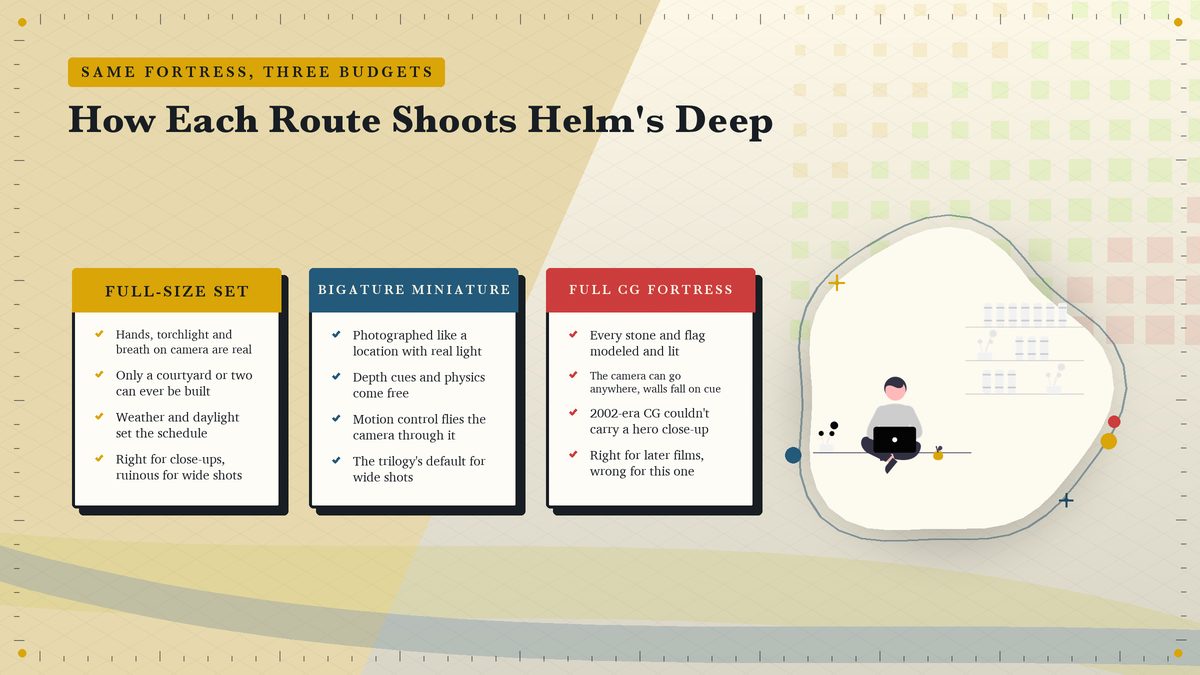
Scheduling pushed the same direction. A bigature is expensive once. A CG world is expensive every time the director changes his mind, and Jackson was famous for finding scenes in the edit. A photographed miniature could be recomposited to serve a new cut, while every CG revision meant weeks of render time on 2002 hardware. Across a three-film, years-long production, that flexibility paid for the model shop several times over, as far as I can tell.
Stealing the Formula for Your Own Backyard Siege
You are not going to build a quarter-scale Helm’s Deep, and neither am I. The recipe still breaks into pieces any hobbyist can borrow, though, and the free tooling has caught up with maybe half of what Weta invented. I’d start in four places.
Start with the establishing shot as a miniature. Our guide to forced-perspective miniatures gets you a convincing fortress for the cost of foam board and patience. Shoot it at dusk with a long lens, and let the atmosphere carry the detail you couldn’t build. A soft light behind a thin haze will sell more architecture than a week of extra kit-bashing.
Duplicate extras, but respect the eyelines. Ten friends, a locked camera, and five passes gets you a courtyard that reads as a hundred people, provided nobody crosses in front of a body from a previous pass. The instant someone overlaps a duplicate, the trick dies. Mark your actors’ blocking with tape and keep the crossings clean.
Instance your crowd in Blender. Blender’s geometry-nodes system can scatter hundreds of low-poly figures across a terrain, and the official geometry nodes manual covers the node setup in detail. Render them small, in motion blur, against your miniature, and nobody counts noses. One warning from experience, or at least from watching friends try this. Keep your instanced figures in the deep background, because mid-ground duplicates under sharp light is where every beginner’s shot falls apart.
Block the battle before you shoot a frame of it. Jackson’s crew rehearsed the siege as a timed animatic long before the cameras rolled, and you can steal that habit with free software and an afternoon. Our look at how blockbusters plan their biggest shots covers the method. Even a ten-panel sketch of your own siege will expose the shots you can’t afford before they eat a weekend.
Grade everything together, last. The single biggest reason amateur composites look pasted is that each element got color-corrected separately. Helm’s Deep works because five sources share one rainy, smoky palette, so match yours to the grimmest plate and drag the rest toward it without mercy.
That last point is honestly the whole secret. Nobody on the crew needed any single element to be perfect. They needed every element to agree, and smoke helps enormously with that, which is why our DIY fog and haze guide might be the most useful ten dollars you spend on a miniature shoot.
The Legacy Nobody Argues With
MASSIVE outlived the trilogy by decades. The brain-per-agent approach it pioneered is now how basically every big battle gets built, whether the tool is Massive itself or one of the crowd systems that followed it, and its credits stretch across the years into productions like King Kong and the armies of Westeros. Digital doubles went from a stunt trick to standard practice, and you rarely know they’re there, which is the entire job description. Game engines picked up the same idea later, and real-time crowd tools now let an indie developer stage a Helm’s Deep of their own on a laptop, which would have melted a 2002 render farm. The bigature had the opposite fate, fading as physically based rendering matured, but its fingerprints sit all over the modern hybrid-everything pipeline we traced in the modern CGI pipeline breakdown.
What’s worth stealing isn’t any one technique, though. It’s the discipline of matching each problem to the tool that lies cheapest. Helm’s Deep works because a physical wall met digital soldiers under one consistent sky, and nobody in the theater ever spotted the join. The next time a battle scene feels oddly hollow, you’ll know what to look for, and it won’t be whether it’s practical or CG. It’ll be whether the seams are where the filmmakers wanted them.
Related reading on this site: miniature sets that look full-size, practical vs. CGI budgets, and the modern CGI pipeline. External sources are checked periodically; figures like agent counts vary by source and are given as commonly cited values.