Long before CGI could render a dragon in an afternoon, filmmakers
moved monsters by hand, one frame at a time. This is the story of the technique that refused
to die, and why directors keep coming back to it.
There’s a particular kind of magic in knowing an object is real. You can
hear it in the way a stop-motion puppet lands on a table. That tiny, honest thud happens
because an actual little figure hit an actual little table, and no render farm on earth
produced it. A person leaned over a set the size of a coffee table and nudged the figure
twelve times to make one second of film, and somewhere in all that fuss the object picked up
a weight that pixels still haven’t matched.
Stop-motion is the oldest special effect still in regular use. Photographers were
trick-stopping cameras in the 1890s, before anyone said the word “Hollywood” with a straight
face, and the core idea hasn’t moved since: pose a real thing, photograph it, move it a
little, photograph it again, and repeat until your patience files a formal complaint. That’s the job, unchanged for a century. If you want the definition, the terminology, and the long view of the technique,
the stop-motion overview on Wikipedia
is a solid reference, kept current by people who genuinely love this stuff. The rest of this
article is production lore, which I find a lot more fun.
I’ll admit my bias now. In an era of GPU renderers there’s something almost defiant about
this craft, and the lineage that runs from a fur-covered gorilla in 1933 to a cheese-loving
inventor in a clay sweater is one of the stranger through-lines in cinema. It’s also, and
this matters, the one “big” movie effect a determined hobbyist can pull off in a spare bedroom with hardware from a drawer. That’s it for entry requirements. We’ll get there.
One Second at a Time: How Stop-Motion Actually Works
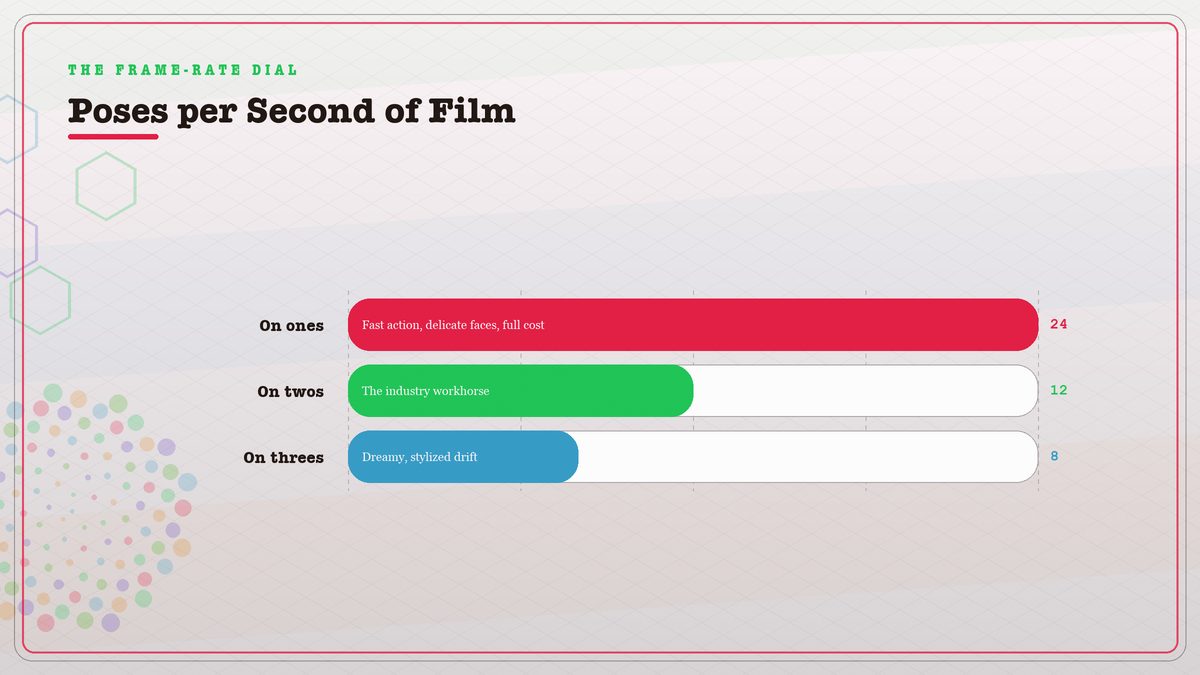
Film runs at 24 frames per second, and stop-motion animators borrow a page from
traditional 2D animation to cut the workload in half. Most movement is shot “on twos,” one
pose photographed across two frames, which means twelve tiny adjustments per second of finished film. Twelve is the magic number. Fast action and delicate faces go “on ones,” the full 24. Dreamy or stylized
sequences sometimes stretch to “threes,” eight poses a second, and that is why those shots
feel floaty and hand-cranked rather than crisp. The audience can’t name the difference, but
they feel it, the way you feel a song played slightly behind the beat.
Between poses, the animator is fighting physics in miniature. An armature wants to sag
back to its rest position; foam wants to spring; a lamp that’s been burning for six hours
drifts in color temperature, and frame 341 suddenly doesn’t match frame 340. A metal
skeleton inside the puppet, basically, held together by tension and tiny screws.
Professionals monitor all of this with frame-grabber software that overlays the live camera
view on the last frame, so they can see how far a hand or eyebrow moved before they commit
to the next nudge. Beginners cover the same ground with sheer discipline: touch the figure
as little as possible, shoot, check, adjust again.
One number puts the whole endeavor in perspective. A full-time animator on a feature is
often pleased with a few seconds of finished footage at the end of a good week. Not minutes. Seconds. I said a few; some productions count it in single digits per animator, and nobody
on those crews thinks that’s strange anymore.
1925–1933: King Kong Puts Puppetry on the Map
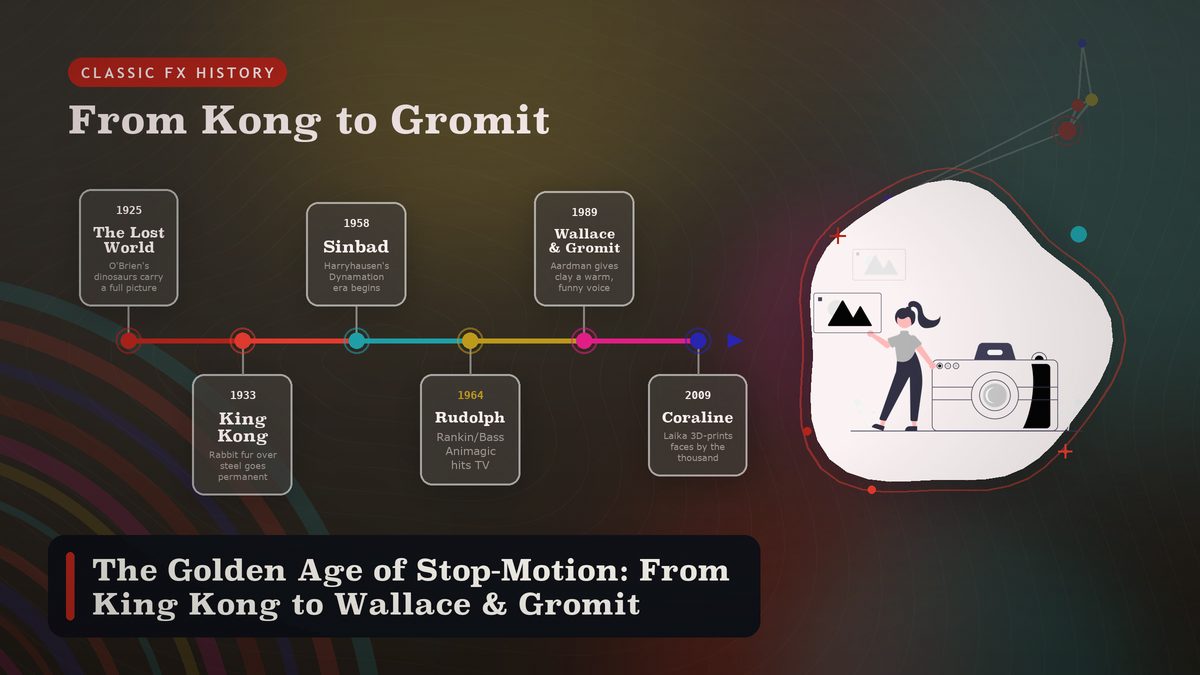
Willis O’Brien had been experimenting with stop-motion dinosaurs since the early 1920s,
and his first major showcase was The Lost World in 1925, which put animated
prehistoric beasts on screen years before sound film settled into the standard. The picture
that made the technique a permanent part of the language, though, was King Kong in
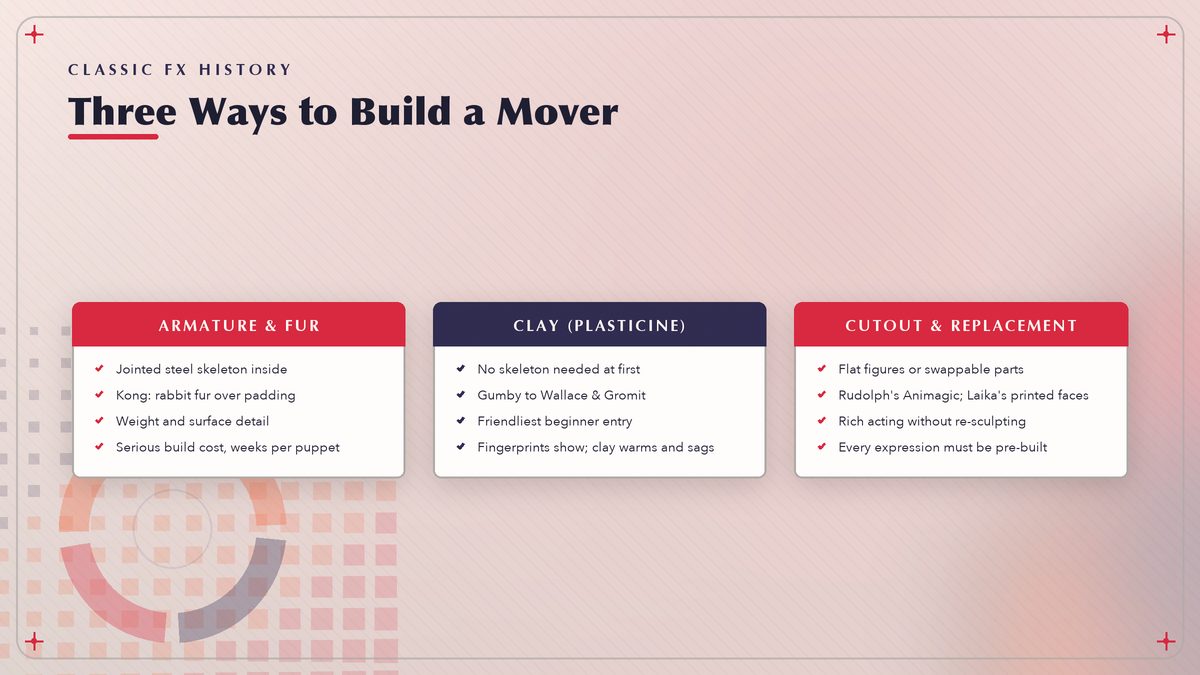
1933. O’Brien and model-maker Marcel Delgado built an eighteen-inch gorilla around a jointed
metal skeleton, padded it, and wrapped it in rabbit fur. That fur rippled with every touch of
an animator’s fingers, which is why Kong seems to bristle with life in a way smooth models
never did. Half the storm of movement on screen is performance, and half is just hair being pushed around twelve times a second. The ape also carried the film’s entire emotional load, which is a big assignment for eighteen inches of fur over steel.
The film earned its place in the Library of Congress’s
National Film Registry,
and it deserves the spot. Kong proved that a miniature could hold an audience’s full
emotional attention; viewers will cry over a handmade ape if the performance underneath is
honest. That lesson has echoed through every era since, and it cost the crew weeks of hot,
fiddly labor to learn.
Shooting was brutal even by the standards of the day. O’Brien’s team photographed the big ape one carefully braced pose at a time while fur, gravity, a hot stage light all worked against them, and the full-size actors in the foreground plates had to be shot first so the
miniature action could be matched to them. A single battle scene could eat weeks of
shooting, which was simply what the technique demanded.
The Creature Decades: Harryhausen and the Art of the Fight
O’Brien’s protégé Ray Harryhausen turned stop-motion from a spectacle into a storytelling
tool. Working largely alone, he animated the monsters for The 7th Voyage of Sinbad
in 1958 and Jason and the Argonauts in 1963, along with a string of other
adventures, and he developed a split-screen method he called Dynamation that let his
creatures share a live-action frame with actors. The skeleton swordfight in Jason,
seven skeletons dueling real performers on location, is still studied frame by frame more
than sixty years on. If your effects technique is being reverse-engineered six decades later,
you won.
What Harryhausen understood instinctively was contact. His monsters grabbed, recoiled, leaned on the real world, so the impossible thing read as physical weight. He built that contact in the optical printer, splitting the frame with a matte so a live-action plate and his creature could share one strip of film, actor and monster eye to eye. Fiddly, patient work. It is the same instinct that made Kong’s fur work: build a real object, let real physics leak into the shot, and the audience’s brain fills in the rest of the illusion without being asked.
Television kept the craft fed through the middle of the century. Art Clokey’s
Gumby brought clay characters into American living rooms through the fifties, and
the Rankin/Bass specials, Rudolph the Red-Nosed Reindeer in 1964 being the one
everybody knows, used a Japanese process they branded “Animagic” to make stop-motion a
holiday institution. Will Vinton’s studio later coined the word “claymation” and took home
an Oscar for Closed Mondays in 1974, giving the technique the name your grandmother
still uses for all of it, Gumby included.
Bristol Changes Everything: Aardman and the Clay Comedy
By the late 1980s the technique was commercially dormant, respected and museum-ish and
nowhere near a blockbuster. Then a film-school graduate named Nick Park at a small Bristol
outfit called Aardman made A Grand Day Out and Creature Comforts, and
stop-motion woke up with a brand-new personality: warm, British, funny. Wallace and his dog
Gromit, inventor and silent eye-rolling co-pilot, became the most beloved clay characters
since Gumby, and the studio’s site at aardman.com
traces a run of features from Chicken Run in 2000 through Shaun the Sheep
that made Bristol the world capital of the craft.
The Aardman look is handmade on purpose, down to the animators’ thumbprints left in the
Plasticine. A fingerprint says a person touched this, and the studio decided that was a
feature rather than a flaw. Their work, catalogued by the
British Film Institute, pointed the technique at
something the monster era never bothered with: ordinary life rendered in clay. A trip to
the shops. A wrong pair of trousers. These films moved serious box office without a single
CGI creature, which still surprises people who assume stop-motion is a novelty act.
Nowadays the pipeline runs both ways. Directors raised on CGI increasingly reach back for a handmade object when a scene needs soul, and you’ll find stop-motion creatures and title sequences turning up inside otherwise fully digital films, because one tactile thing on screen pulls every other effect toward believability.
A fingerprint in the clay is the entire argument for the technique:
someone touched this, twelve times a second.
The Modern Era: Laika, 3D Printing, and the Hybrid Future
Disney’s The Nightmare Before Christmas in 1993, directed by Henry Selick, belongs in this stretch of the story too. Jack Skellington’s expressive range came from a wardrobe of swappable heads, and the production is still quoted, with a straight face, using the phrase “a minute a week” as the pace of a healthy crew. Every swappable head was sculpted, molded, and painted by hand before a single frame rolled. Thirteen months of shooting. Zero rendered pixels. The film made stop-motion bankable in Hollywood again, and it did it while looking like a haunted dollhouse, which takes real nerve.
Weight is the whole point, and Laika pushed it furthest. The newest heavyweight is the Oregon studio behind Coraline in 2009,
ParaNorman in 2012, and Kubo and the Two Strings in 2016. Their
innovation is rapid prototyping. Instead of hand-sculpting every facial expression, they
design faces on a computer, 3D-print thousands of replacement parts, and swap them frame by
frame. The payoff is facial acting the Kong crew could only dream about, because a character
can now raise an eyebrow halfway, a move an armatured brow physically cannot make. Reported
figures for Coraline run to over two hundred thousand printed faces for one
puppet, which sounds like a typo until you remember each one covers a fraction of a second
of screen time. Their filmography lives at laika.com.
None of this happens in a vacuum now. Modern stop-motion shoots on digital still cameras
with instant frame playback, support rigs get painted out with the same compositing software
you’d see on any effects blockbuster, and plenty of “stop-motion” features blend in CG
smoke, water, and crowd extensions between the handmade frames. The object at the center
stays real. The digital tools just absorb the jobs that used to grind the charm out of the
process, like erasing the rod that held Kong’s heir aloft mid-leap.
Try It Yourself: A Kitchen-Table Start
Everything below works with gear you probably own already.
Now for the encouraging part. Stop-motion is the most accessible “real movie effect”
there is, because the core equipment is a phone, a desk lamp, and something that holds a
pose. Clay, a toy car, a paper cutout, all fine. Lock the phone down (a stack of books is a
legitimate tripod; I’ve used one, and the wobble either adds character or ruins the shot,
depending on your patience), open any stop-motion app with onion-skinning, and animate one
second of a clay figure lifting its head. Twelve nudges, maybe fifteen minutes all in, and the hands learn faster than any explanation. You’ll
understand the technique in your hands in a way no article can transmit.
What you learn fast is that small moves read big. A quarter-turn of a clay head plays as a thoughtful glance. Subtlety does the heavy lifting. Overshoot it and your character snaps like a startled chicken. Which is
the same economy the 1933 crew worked with: one small adjustment, one clean intention,
repeated until the shot is true.
If you catch the bug, the upgrade path is short and cheap. A spool of aluminum armature
wire from the craft store (roughly $8–12) lets you build a posable skeleton that holds a
pose far better than solid clay. A blob of Plasticine over the wire, two bead eyes, and you
have a puppet the 1933 crew would recognize on sight. Tie-downs, the threaded bolts that
screw a puppet’s feet to the floor of the set so it can bear weight, can wait until your
first walking shot demands them; before that, a little loop of wire around the ankles works
well enough for practice. So don’t overbuild. Animators of every era agree that the figure
matters less than the patience behind it.
| Setup | Cost | Best for | Catch |
|---|---|---|---|
| Phone + book stack | $0 | First tests, clay experiments | Wobble risk; tap the screen to shoot and you nudge the frame |
| Phone + $20 tripod + remote shutter | ~$20–30 | Serious short films | Fixed lens; no manual focus on some models |
| Used DSLR + manual lens | $150+ | Image quality a festival would accept | Needs a capture laptop and real lights |
- Lock everything. Camera, lights, set. Any drift becomes a flicker that no app can repair after the fact.
- Shoot on twos. Twelve poses per second, half the work, and it reads like film.
- Plan one second. Sketch the start pose and the end pose before you touch the figure; the middle mostly takes care of itself.
- Light hot, shoot fast. Cheap LEDs drift in color over a long day, and mismatched frames are the classic beginner giveaway.
animate; cold clay cracks and holds every finger dent like a grudge. And leave the
thumbprint in. On camera it reads as authorship, because it is.
Expect the classic failures, everyone gets them. The most common is flicker, where a bumped light or an auto-exposure drift makes the finished shot pulse like a dying fluorescent tube, and the only honest cure is to lock the exposure and stop touching things. The second classic is the bumped set, a single nudge of the table that turns a careful walk into a small earthquake, which is why pros bolt the set to the floor and the camera to its stand. And when a puppet droops between frames, warm the clay again, because cold Plasticine lies to you about how the pose will hold through the next dozen photographs.
Software closed the last big gap. A tethered capture program ghosts the previous frame under the live view so you can nudge the figure and compare before shooting without ever touching the camera, and that one change removes the oldest source of ruined takes. Prevention beats repair. Dragonframe is what the professionals use; a handful of free apps cover the same ground well enough for a first short. Most beginners outgrow the free ones inside a month or so, which is probably the right schedule.
Why It Endures
Every few years somebody declares stop-motion finished, and every few years a studio like
Aardman or Laika ships a film that makes the obituary look silly. The technique survives
because it answers a need digital effects don’t: it gives unreal things real weight. Film schools still teach the craft for that reason, because there is no faster way to learn what a single frame is worth than moving something twelve times to earn one second of film. A
puppet that obeys gravity, casts a true shadow, and sits in genuine light is doing something
a render has to sweat to fake. Audiences rarely articulate the difference, but they register
it every time.
For the person at the table, the gap between watching this effect and making it is
smaller than for anything else in this series. Kong began as someone’s hands moving a fur-covered armature in a hot room in 1932. Wallace began as a film student’s sketch. The next one starts wherever you’re sitting. Probably with worse lighting and a borrowed phone.
Related read on this site: How the Jurassic Park Dinosaurs Were Made — the next chapter of creature-effects history, when puppets first shared the screen with CGI. Sources checked October 2026.